2025 Investment Tax Credit for Standalone Energy Storage Explained
Anúncios
The 2025 Investment Tax Credit (ITC) for standalone energy storage provides substantial financial incentives to accelerate the deployment of critical clean energy infrastructure throughout the United States.
As the United States accelerates its transition to a cleaner energy future, understanding the mechanisms that drive this shift becomes paramount. Among these, the 2025 Investment Tax Credit for Standalone Energy Storage stands out as a pivotal financial incentive. This guide aims to demystify this crucial policy, offering a comprehensive look at its implications for developers, investors, and the broader energy landscape.
The foundation of the Investment Tax Credit (ITC)
The Investment Tax Credit (ITC) has long been a cornerstone of renewable energy development in the United States. Initially focused on solar and other renewable generation technologies, its expansion to include standalone energy storage systems represents a significant policy evolution. This change acknowledges the critical role that energy storage plays in grid modernization, reliability, and the effective integration of intermittent renewable sources.
The ITC allows taxpayers to subtract a percentage of the cost of eligible energy property from their federal tax liability. For standalone energy storage, this means a direct reduction in the upfront capital expenditure for qualifying projects. This financial boost makes otherwise marginal projects economically viable, encouraging greater investment and deployment across various scales, from utility-scale batteries to commercial and industrial applications. The credit’s existence signifies a strong governmental commitment to building a resilient and sustainable energy infrastructure.
Historical context and evolution
Historically, energy storage often qualified for the ITC only when paired directly with a renewable energy generation source, such as solar panels. The pivotal shift occurred with the Inflation Reduction Act (IRA) of 2022, which introduced a standalone ITC for energy storage technologies. This change decoupled storage from generation, recognizing its independent value to the grid.
- Pre-IRA: Storage typically had to be charged by a renewable energy source to qualify.
- Post-IRA: Standalone storage, regardless of charging source, can qualify for the full credit.
- Eligibility criteria: Systems must have a capacity of at least 5 kilowatt-hours (kWh).
This evolution reflects a maturing understanding of energy systems, where storage is not merely an accessory but a foundational component. It enables greater grid flexibility, enhances energy security, and facilitates the deeper penetration of renewables by mitigating their variability. Understanding this policy shift is crucial for anyone looking to invest in or develop energy storage projects in the coming years.
Eligibility criteria for standalone energy storage in 2025
For a standalone energy storage project to qualify for the 2025 ITC, it must meet specific criteria outlined by the Internal Revenue Service (IRS) and the Department of Energy. These requirements ensure that the incentives are directed towards projects that genuinely advance energy independence and environmental goals. Adhering to these guidelines is essential for project developers seeking to maximize their financial benefits.
The primary eligibility hinges on the system’s capacity and its operational purpose. While the base credit is substantial, additional bonus credits can significantly increase the overall incentive, making projects even more attractive. These bonus credits are often tied to domestic content, location in energy communities, or serving low-income communities, aligning with broader economic development and equity goals.
Key requirements for qualification
To be considered for the ITC, an energy storage system must meet several fundamental criteria. These are designed to ensure the system contributes meaningfully to the energy grid and represents a significant investment in clean technology.
- Minimum capacity: The energy storage system must have a capacity of at least 5 kilowatt-hours (kWh). This threshold ensures that the credit supports systems capable of providing meaningful grid services or energy backup.
- New construction or substantial rebuild: The credit generally applies to new equipment. For existing equipment, a significant portion (typically 20%) of its fair market value must be replaced to qualify as a substantial rebuild.
- Technology neutrality: The ITC is largely technology-neutral, meaning it applies to various storage technologies, including lithium-ion batteries, flow batteries, and potentially other emerging solutions, as long as they meet the capacity and operational criteria.
Beyond these core requirements, developers must also consider the project’s placed-in-service date and ensure proper documentation is maintained for IRS review. Careful planning and adherence to these criteria are critical for securing the full tax credit benefit. This ensures that the investment contributes to a robust and sustainable energy future.
Understanding the base and bonus credit rates
The 2025 Investment Tax Credit for standalone energy storage is not a flat rate but a tiered system, offering a base credit and several opportunities for bonus credits. This structure is designed to incentivize not only the deployment of storage but also to promote specific policy objectives, such as domestic manufacturing, job creation in disadvantaged communities, and equitable access to clean energy benefits. Navigating these various rates is key to maximizing the financial viability of a project.
The base credit provides a solid foundation, significantly reducing project costs. However, the true financial leverage often comes from stacking the available bonus credits. These additional incentives can elevate the credit value substantially, making projects more competitive and attractive to investors. Understanding how to qualify for each bonus is therefore paramount for developers and financiers.
Breakdown of credit percentages
The base ITC for standalone energy storage is set at 30% for projects that meet prevailing wage and apprenticeship requirements. If these requirements are not met, the base credit can drop to 6%. This emphasizes the government’s commitment to fair labor practices within the clean energy sector.
Several bonus credits can be added to the base rate:
- Domestic content bonus: An additional 10% credit is available for projects that meet specific domestic content requirements for steel, iron, and manufactured products. This encourages the growth of a domestic clean energy supply chain.
- Energy community bonus: Projects located in designated ‘energy communities’ (areas historically reliant on fossil fuel industries) can receive an additional 10% credit. This aims to foster economic transition in these regions.
- Low-income communities bonus: An extra 10% or 20% credit is available for projects located in low-income communities or serving low-income households, promoting energy equity.
By strategically structuring projects to qualify for multiple bonus credits, developers can achieve an ITC as high as 70%, dramatically improving project economics. This multi-layered incentive system underscores a comprehensive approach to energy transition, addressing economic, social, and environmental goals simultaneously.
Navigating the prevailing wage and apprenticeship requirements
A critical aspect of securing the full 30% base Investment Tax Credit for standalone energy storage in 2025 involves adherence to prevailing wage and apprenticeship requirements. These provisions, introduced with the Inflation Reduction Act, are designed to ensure that the growth of the clean energy sector also supports high-quality jobs and workforce development. Failing to meet these standards can significantly reduce the tax credit, impacting project profitability.
Developers must meticulously plan and execute their projects to comply with these labor standards. This includes understanding the specific wage rates for various crafts and trades in the project’s geographic area, as well as establishing or participating in approved apprenticeship programs. Compliance is not merely a formality but a fundamental component of the ITC’s broader policy objectives.
Understanding the compliance framework
The prevailing wage requirement mandates that all laborers and mechanics employed in the construction, alteration, or repair of a qualifying facility must be paid wages no less than the prevailing local wage rates determined by the Department of Labor. This applies to both direct employees and subcontractors.
- Record keeping: Thorough documentation of wages paid and hours worked is essential for demonstrating compliance.
- Correction period: There are provisions for correcting underpayments, though penalties may apply if not addressed promptly.
The apprenticeship requirement dictates that a certain percentage of the total labor hours for construction, alteration, or repair must be performed by qualified apprentices. This percentage varies depending on when construction begins, steadily increasing over time.
- Registered programs: Apprentices must be enrolled in programs registered with the Department of Labor or a recognized state apprenticeship agency.
- Apprentice-to-journeyperson ratios: Adherence to established apprentice-to-journeyperson ratios is also required, ensuring proper supervision and training.
Meeting these requirements demands proactive engagement with labor unions, workforce development agencies, and a clear understanding of federal guidelines. Compliance not only secures the full ITC but also contributes to a skilled and fairly compensated clean energy workforce, aligning with the spirit of the legislation.
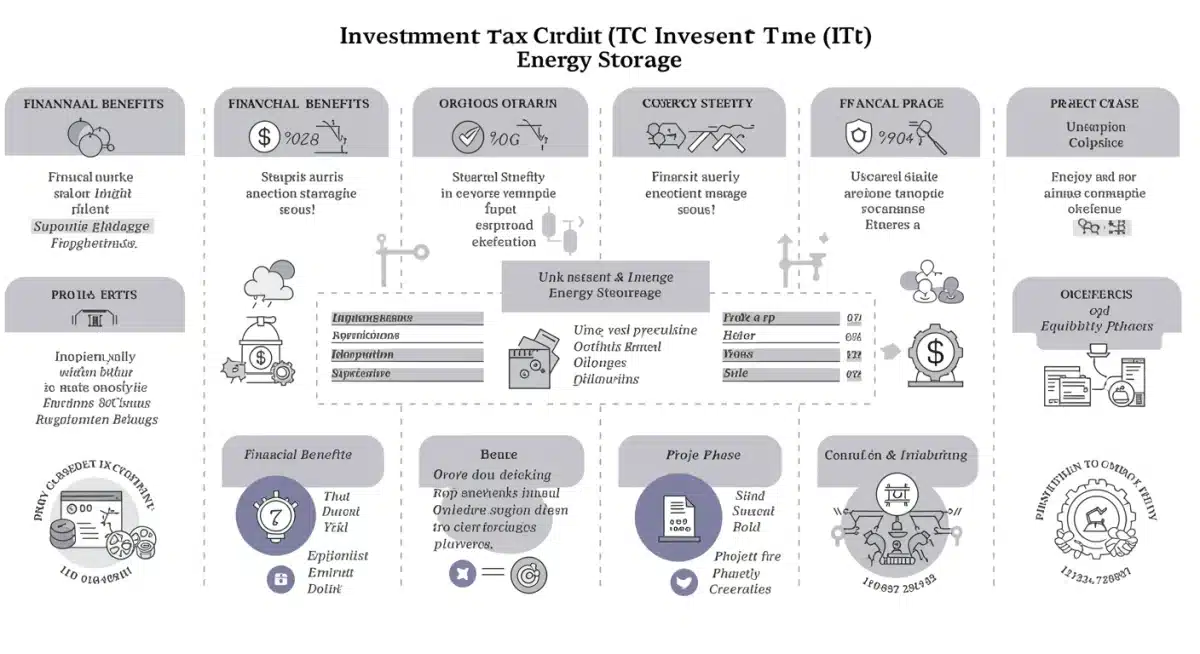
Maximizing financial benefits: strategies and considerations
To fully leverage the 2025 Investment Tax Credit for Standalone Energy Storage, developers and investors need to adopt strategic approaches that go beyond mere compliance. Maximizing financial benefits involves a deep understanding of the ITC’s nuances, careful project planning, and an awareness of other complementary incentives. This holistic perspective ensures that projects are not only technically sound but also financially optimized.
Successful maximization often stems from a combination of factors, including selecting the right project location, sourcing materials strategically, and structuring partnerships effectively. Each decision can have a ripple effect on the project’s overall eligibility for various bonus credits, ultimately determining the magnitude of the tax credit received. Therefore, a comprehensive strategy is indispensable for unlocking the full potential of these incentives.
Key strategies for optimization
Several strategies can significantly enhance the financial returns from the ITC. These involve careful consideration during the planning and development phases of an energy storage project.
- Domestic content planning: Early engagement with supply chain partners to ensure that steel, iron, and manufactured products meet the domestic content thresholds can secure an additional 10% credit. This requires meticulous tracking and certification.
- Site selection: Prioritizing sites within designated ‘energy communities’ can unlock another 10% bonus. This involves researching and confirming eligibility of potential project locations.
- Community benefit focus: Designing projects to serve low-income communities or households can yield a 10% or 20% bonus. This often involves partnerships with community organizations and careful project structuring to demonstrate direct benefit.
- Stacked incentives: Explore the possibility of combining the ITC with other state or local incentives, grants, or accelerated depreciation (MACRS) to further enhance project economics.
Furthermore, understanding the transferability and direct pay options introduced by the IRA can provide additional flexibility for project financing. Transferability allows eligible entities to sell their tax credits to unrelated third parties for cash, while direct pay enables certain tax-exempt entities to receive the value of the credit as a direct payment. These mechanisms broaden the pool of potential investors and facilitate project development, making the ITC a powerful tool for accelerating clean energy deployment.
The impact on the energy storage market and future outlook
The introduction and continued strength of the 2025 Investment Tax Credit for Standalone Energy Storage are profoundly reshaping the energy storage market in the United States. This robust financial incentive is acting as a catalyst, accelerating deployment, driving innovation, and fostering a more resilient and sustainable energy grid. Its influence extends beyond mere project financing, impacting manufacturing, job creation, and overall market dynamics.
The ITC’s predictable and substantial financial support provides a clear signal to investors and developers, reducing risk and encouraging long-term commitments to energy storage technologies. This certainty is crucial for a nascent but rapidly growing industry, allowing for economies of scale, technological advancements, and the development of a skilled workforce. The future outlook for energy storage, heavily influenced by the ITC, is one of significant expansion and integration into the broader energy ecosystem.
Market acceleration and innovation
The ITC has significantly lowered the financial barriers to entry for energy storage projects, leading to a surge in deployment across various segments. This increased demand, in turn, stimulates innovation and drives down costs.
- Increased deployment: A noticeable uptick in utility-scale, commercial, and residential battery storage projects.
- Technological advancements: Greater investment in research and development for new battery chemistries and energy management systems.
- Supply chain growth: Stimulates domestic manufacturing and reduces reliance on foreign supply chains, especially with the domestic content bonus.
Looking ahead, the ITC is expected to continue its role as a primary driver for the energy storage market. As the grid evolves to accommodate more renewable energy, the demand for flexible and reliable storage solutions will only grow. The policy provides a stable framework for this growth, ensuring that the necessary infrastructure is built to support a decarbonized energy future. This sustained support is vital for achieving national energy goals and maintaining competitiveness in the global clean energy race.
| Key Aspect | Brief Description |
|---|---|
| ITC Eligibility | Standalone energy storage systems (5 kWh+ capacity) qualify for federal tax credits. |
| Base Credit Rate | 30% for projects meeting prevailing wage and apprenticeship requirements. |
| Bonus Credits | Additional 10-20% for domestic content, energy communities, or low-income benefits. |
| Market Impact | Accelerates deployment, drives innovation, and fosters a resilient energy grid. |
Frequently asked questions about the 2025 energy storage ITC
The primary benefit is a significant reduction in the upfront capital costs for eligible energy storage projects. This makes developing and installing energy storage systems more financially attractive, accelerating their adoption and contributing to grid stability and renewable energy integration.
Yes, the ITC is largely technology-neutral, meaning various storage technologies like lithium-ion, flow batteries, and other advanced systems can qualify. The key is that the system must have a capacity of at least 5 kilowatt-hours and meet other general eligibility criteria.
Projects can earn bonus credits by meeting specific criteria such as using domestically manufactured components (domestic content bonus), being located in designated energy communities, or directly benefiting low-income communities or households. Each bonus can add 10% to 20% to the base credit.
To receive the full 30% base ITC, projects must pay laborers and mechanics no less than the prevailing local wage rates and ensure a certain percentage of labor hours are performed by qualified apprentices enrolled in registered programs. This promotes fair labor practices and workforce development.
The ITC significantly enhances grid reliability and resilience by promoting the widespread deployment of energy storage. It enables greater integration of intermittent renewable energy sources, reduces peak demand stress, and supports the overall modernization and decarbonization of the US energy infrastructure.
Conclusion
The 2025 Investment Tax Credit for Standalone Energy Storage represents a landmark policy, signaling a strong national commitment to a clean, resilient, and equitable energy future. By offering substantial financial incentives, it accelerates the deployment of critical storage infrastructure, drives innovation, and fosters economic growth in the clean energy sector. For developers and investors, a thorough understanding of its eligibility criteria, base and bonus credit structures, and compliance requirements is essential to maximize benefits and contribute effectively to the nation’s energy transition. The ITC is not just a tax break; it’s a strategic investment in the future of American energy.