Optimize Energy Storage: 90% Efficiency by 2025

Anúncios
Achieving 90% efficiency in energy storage systems by 2025 requires the strategic integration of smart management technologies, advanced battery chemistries, and predictive analytics to minimize energy losses and maximize operational output.
Are you ready to revolutionize how you manage energy? The goal of Optimizing Your Energy Storage System: Achieving 90% Efficiency with Smart Management in 2025 is not just ambitious; it’s within reach. As the demand for reliable and sustainable energy solutions grows, understanding and implementing advanced strategies for energy storage becomes paramount. This guide will delve into the critical aspects and cutting-edge technologies that will propel your system towards unprecedented efficiency.
The Imperative for High-Efficiency Energy Storage
The energy landscape is rapidly evolving, driven by the increasing adoption of renewable sources like solar and wind. However, the intermittent nature of these sources necessitates robust and efficient energy storage solutions. Achieving 90% efficiency in energy storage systems is no longer a distant dream but a critical benchmark for grid stability, economic viability, and environmental sustainability.
High efficiency translates directly into reduced energy waste, lower operational costs, and a smaller carbon footprint. This makes efficient storage a cornerstone of modern energy infrastructure, pivotal for both utility-scale applications and residential setups. Without optimized storage, the full potential of renewable energy remains untapped, leading to curtailed generation and reliance on fossil fuel backups.
Why 90% Efficiency Matters
- Economic Savings: Less energy loss means more usable energy, directly reducing costs for consumers and operators.
- Grid Stability: Highly efficient systems can respond faster and more effectively to grid demands, preventing blackouts and ensuring consistent power supply.
- Environmental Impact: Maximizing the use of stored renewable energy reduces the need for fossil fuel-based generation, lowering greenhouse gas emissions.
- Resource Optimization: Efficient systems make the most of available energy, prolonging the lifespan of storage components and reducing the need for new infrastructure.
The drive towards 90% efficiency is not merely a technical challenge; it’s an economic and environmental necessity. It underpins the transition to a cleaner, more resilient energy future, ensuring that every watt generated from renewable sources is utilized to its maximum potential.
Understanding Current Energy Storage Technologies
Before diving into optimization, it’s crucial to grasp the current state of energy storage technologies. While lithium-ion batteries dominate the market due to their high energy density and decreasing costs, other technologies are also playing significant roles, each with its own set of advantages and limitations. The choice of technology often depends on the specific application, desired duration of storage, and environmental considerations.
Lithium-ion technology continues to advance, with improvements in cycle life, safety, and specific energy. However, concerns regarding raw material sourcing and end-of-life disposal are prompting research into alternative chemistries. Flow batteries, for instance, offer excellent scalability and long-duration storage capabilities, making them attractive for grid-scale applications where space is less of a constraint.
Key Storage Technologies and Their Efficiency
- Lithium-ion Batteries: Widely used, offering efficiencies typically between 85-95%. Best for short-to-medium duration storage.
- Flow Batteries: Promising for long-duration storage with efficiencies around 70-85%. Separated energy and power components allow for easy scaling.
- Lead-Acid Batteries: Older technology, less efficient (70-85%) and shorter lifespan, but still used in specific niche applications due to lower upfront cost.
- Pumped Hydro Storage: High efficiency (75-85%) and large scale, but geographically limited and high initial capital investment.
- Compressed Air Energy Storage (CAES): Moderate efficiency (40-70%) but capable of very large-scale, long-duration storage.
Each technology has a role to play in the diverse energy storage landscape. Achieving 90% efficiency across the board requires not only improving individual technologies but also intelligently integrating them into hybrid systems that leverage their respective strengths. Research and development continue to push the boundaries, seeking safer, more sustainable, and ultimately more efficient storage solutions.
The Role of Smart Management Systems
Achieving 90% efficiency in energy storage systems by 2025 will largely depend on the sophistication of smart management systems. These systems act as the central nervous system of an energy storage installation, optimizing performance, extending lifespan, and ensuring seamless integration with the broader grid. Without intelligent control, even the most advanced battery hardware would struggle to reach its full potential.
Smart management systems utilize a combination of hardware and software to monitor, control, and predict the behavior of energy storage units. They analyze real-time data on energy generation, consumption patterns, grid conditions, and battery health to make instantaneous decisions. This proactive approach minimizes energy losses during charging and discharging cycles and prevents premature degradation of storage components.
Components of an Advanced Smart Management System
- Battery Management Systems (BMS): Essential for monitoring individual battery cells, balancing charge, and protecting against overcharge/discharge.
- Energy Management Systems (EMS): Oversee the entire energy flow, optimizing charging/discharging based on real-time grid conditions, weather forecasts, and energy prices.
- Predictive Analytics: Uses historical data and machine learning to forecast energy demand, supply, and potential system anomalies, enabling pre-emptive adjustments.
- Artificial Intelligence (AI): AI algorithms learn and adapt to complex patterns, continuously refining optimization strategies for peak efficiency.
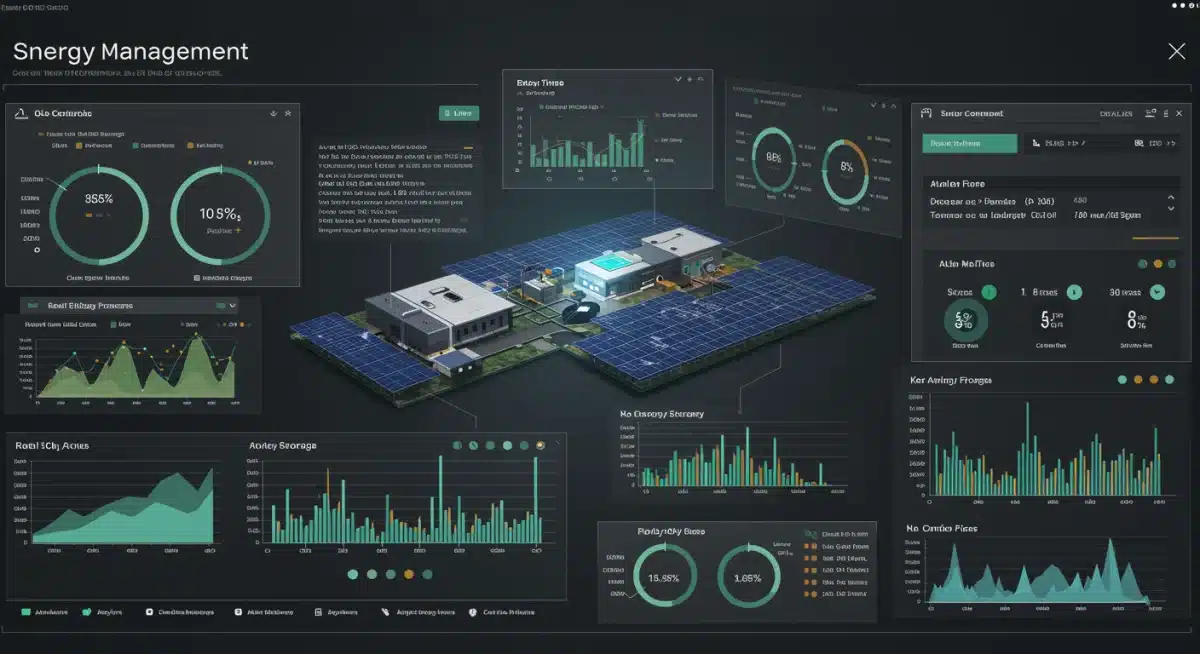
Smart management is not just about control; it’s about intelligent adaptation. By leveraging data and advanced algorithms, these systems can dynamically adjust operations to achieve maximum efficiency, ensuring that energy is stored and released precisely when and where it is most needed, minimizing waste and maximizing return on investment.
Leveraging AI and Machine Learning for Optimization
The integration of Artificial Intelligence (AI) and Machine Learning (ML) is a game-changer for optimizing energy storage systems. These technologies move beyond traditional rule-based controls, enabling systems to learn from vast amounts of data, identify complex patterns, and make highly accurate predictions. This capability is critical for pushing efficiency towards the 90% mark by 2025.
AI and ML algorithms can process real-time data from various sources, including weather forecasts, energy market prices, grid demand, and individual battery performance metrics. By analyzing these inputs, they can predict optimal charging and discharging schedules, anticipate potential faults, and even suggest maintenance routines that extend the operational life of the storage system. This level of dynamic optimization is unprecedented.
Applications of AI and ML in Energy Storage
- Predictive Maintenance: AI can analyze battery health data to predict failures before they occur, scheduling maintenance proactively and preventing costly downtime.
- Demand Forecasting: ML algorithms can accurately forecast energy demand and supply, allowing the system to charge when energy is cheap and abundant, and discharge during peak demand.
- Grid Services Optimization: AI enables storage systems to provide ancillary services to the grid, such as frequency regulation and voltage support, earning revenue and enhancing grid stability.
- Battery Life Extension: By optimizing charge/discharge cycles and temperature management, AI can significantly prolong the useful life of battery assets.
The continuous learning capability of AI and ML means that energy storage systems become smarter and more efficient over time. As more data is gathered and processed, the algorithms refine their strategies, leading to incremental but significant gains in overall system efficiency and reliability. This technological synergy is fundamental to achieving the ambitious 90% efficiency target.
Advanced Battery Chemistries and Their Impact
While smart management systems provide the brains, advanced battery chemistries offer the brawn needed to reach 90% efficiency. Ongoing research and development in materials science are leading to new battery types and significant improvements in existing ones. These advancements focus on increasing energy density, improving cycle life, enhancing safety, and reducing costs, all of which contribute to higher overall system efficiency.
Beyond the ubiquitous lithium-ion, emerging chemistries like solid-state batteries, sodium-ion batteries, and various redox flow battery configurations are showing immense promise. Solid-state batteries, for example, could offer higher energy densities and improved safety profiles compared to their liquid-electrolyte counterparts. Sodium-ion batteries, leveraging abundant raw materials, present a more sustainable and potentially cheaper alternative.
Innovations Driving Higher Efficiency
- Solid-State Batteries: Potentially safer, higher energy density, and longer cycle life, reducing energy losses during charge/discharge.
- Sodium-Ion Batteries: Abundant materials, lower cost, and comparable performance for certain applications, contributing to economic efficiency.
- Improved Lithium-ion Cathodes/Anodes: New material compositions (e.g., silicon anodes) are boosting energy density and reducing internal resistance, thus minimizing heat loss.
- Advanced Electrolytes: Non-flammable and more stable electrolytes enhance safety and allow for wider operating temperature ranges, improving performance in diverse conditions.
The continuous evolution of battery chemistry is vital for increasing the intrinsic efficiency of energy storage. These innovations not only reduce the amount of energy lost as heat during operation but also enable batteries to perform optimally over a longer lifespan, further contributing to the overall efficiency and sustainability of energy storage systems.
Implementing Best Practices for System Optimization
Achieving 90% efficiency in an energy storage system by 2025 is not solely about cutting-edge technology; it also requires meticulous implementation of best practices throughout the system’s lifecycle. From initial design and installation to ongoing operation and maintenance, every stage offers opportunities to enhance efficiency and ensure long-term performance. A holistic approach is essential for maximizing returns and minimizing environmental impact.
Proper sizing of the energy storage system relative to the generation capacity and load demand is a fundamental first step. An undersized system will be overstressed, leading to premature degradation, while an oversized one represents an inefficient capital investment. Furthermore, ensuring optimal thermal management is critical, as extreme temperatures can significantly reduce battery efficiency and lifespan. Regular monitoring and data analysis are also indispensable for continuous improvement.
Key Best Practices for Efficiency
- Accurate System Sizing: Match storage capacity and power output to specific energy needs to avoid under- or over-utilization.
- Optimal Thermal Management: Implement advanced cooling and heating systems to maintain batteries within their ideal operating temperature range.
- Regular Monitoring and Diagnostics: Continuously track key performance indicators (KPIs) like state of charge, state of health, and round-trip efficiency to detect and address issues promptly.
- Software Updates and Upgrades: Keep smart management software current to leverage the latest algorithms and optimization features.
- Strategic Placement: Site energy storage systems in locations that minimize transmission losses and maximize access to renewable generation.
- Hybrid System Integration: Combine different storage technologies (e.g., batteries with thermal storage) to create a more resilient and efficient overall system tailored to diverse demands.
By adhering to these best practices, operators can ensure that their energy storage systems perform at their peak, reliably delivering power with minimal losses. This integrated approach, combining advanced technology with diligent management, is the pathway to achieving and maintaining 90% efficiency in the years to come.
| Key Aspect | Description for 90% Efficiency |
|---|---|
| Smart Management | Utilizing AI/ML for real-time optimization, predictive maintenance, and demand forecasting. |
| Advanced Chemistries | Adopting next-gen batteries (solid-state, sodium-ion) for higher energy density and safety. |
| System Integration | Seamlessly connecting storage with renewables and grid for dynamic response and stability. |
| Best Practices | Implementing optimal sizing, thermal management, and continuous monitoring for longevity. |
Frequently Asked Questions
90% efficiency, or round-trip efficiency, means that for every 100 units of energy put into the storage system, 90 units are successfully discharged and made available for use. The remaining 10 units are lost, typically as heat, during the charging and discharging processes.
Smart management systems use AI and machine learning to optimize charge/discharge cycles, predict demand, and perform predictive maintenance. This intelligent control minimizes energy waste, reduces degradation, and ensures the system operates at its most efficient point, nearing the 90% goal.
Many modern lithium-ion batteries already achieve round-trip efficiencies in the 85-95% range under ideal conditions. The challenge for 2025 is to consistently achieve and exceed 90% across diverse operational scenarios and integrate this high efficiency within broader energy grids.
Advanced chemistries, such as solid-state or improved lithium-ion variants, reduce internal resistance and enhance thermal stability. This minimizes energy loss as heat during charging and discharging, directly contributing to higher intrinsic efficiency and longer system lifespan.
Key challenges include managing thermal losses, integrating diverse component efficiencies, ensuring long-term degradation control, and optimizing for dynamic grid conditions. Overcoming these requires sophisticated software, robust hardware, and continuous data-driven refinement.
Conclusion
The journey towards Optimizing Your Energy Storage System: Achieving 90% Efficiency with Smart Management in 2025 is a multifaceted endeavor, blending technological innovation with strategic implementation. The convergence of advanced battery chemistries, sophisticated AI and machine learning algorithms, and diligent operational best practices is creating a powerful synergy. This synergy not only promises to significantly enhance the efficiency of energy storage to the 90% benchmark but also ensures greater grid stability, economic viability, and a more sustainable energy future. As we move closer to 2025, the focus on smart, integrated, and highly efficient energy storage will be paramount for realizing the full potential of renewable energy and building a resilient power infrastructure.