2025 Residential Solar Outlook: Policy Changes Impacting ROI
Anúncios
The 2025 residential solar outlook is shaped by three key policy changes impacting homeowners’ return on investment, including evolving net metering, federal tax credits, and state-specific incentives.
As we step into 2025, the landscape for residential solar energy in the United States continues its dynamic evolution. Homeowners considering solar installations are keenly interested in how policy shifts might affect their investment. This year, understanding the 2025 outlook for residential solar: 3 key policy changes impacting your ROI this year is more crucial than ever to maximize your return on investment and contribute to a sustainable future.
The Evolving Landscape of Net Metering Policies
Net metering has long been a cornerstone of residential solar economics, allowing homeowners to receive credit for excess electricity sent back to the grid. However, 2025 is set to bring significant modifications to these policies across various states, directly influencing the financial viability of new solar installations.
These changes are often driven by utility companies and state regulators aiming to balance grid stability, energy costs, and the integration of renewable sources. The shift from full retail rate compensation to lower wholesale rates or net billing structures can significantly alter a homeowner’s payback period and overall savings.
State-Specific Net Metering Revisions
Several states are actively reviewing or implementing new net metering frameworks. California’s NEM 3.0, for instance, has already demonstrated how such changes can reshape the market, emphasizing battery storage solutions to maximize self-consumption rather than relying solely on exporting excess energy.
- California’s NEM 3.0: Focuses on time-of-use rates and incentivizes battery storage.
- Arizona’s Successor Tariff: Replaced net metering with an export rate, reducing compensation for exported energy.
- Florida’s Policy Debates: Ongoing discussions around reducing net metering benefits, creating uncertainty for future installations.
- New York’s Community Solar Programs: While not direct net metering, these programs offer alternative pathways for solar savings.
The impact of these revisions extends beyond direct compensation. They influence equipment choices, system sizing, and the overall strategy for residential solar adoption. Homeowners must now consider not just generation, but also energy storage and smart home energy management.
Understanding the specific net metering policies in your state is paramount. These policies dictate how much you save on your electricity bill and how quickly your solar investment pays for itself. As states continue to adapt their energy policies, staying informed about local regulations becomes a competitive advantage for prospective solar owners.
Federal Solar Investment Tax Credit (ITC) Adjustments
The federal Solar Investment Tax Credit (ITC) has been a powerful catalyst for residential solar growth across the United States. For 2025, while the ITC remains a significant incentive, its structure and future trajectory present a key policy change impacting ROI.
The Inflation Reduction Act (IRA) of 2022 extended the ITC at a 30% rate for systems installed through 2032. This long-term stability is a major win for the industry, but understanding the nuances and potential future adjustments is crucial for planning.
Understanding the 30% ITC and Beyond
The 30% credit applies to the cost of installing a new solar energy system. This includes not only the solar panels but also labor costs, permitting fees, and even energy storage devices installed with the solar system. This comprehensive coverage makes it an incredibly valuable incentive.
- Current Rate: 30% for systems installed between 2022 and 2032.
- Step-Down Schedule: The credit is scheduled to step down to 26% in 2033 and 22% in 2034, before expiring for residential systems in 2035.
- Eligibility: Applies to both newly installed systems and certain additions to existing systems.
- Tax Liability: The credit reduces your federal income tax liability dollar-for-dollar.
While the 30% rate is locked in for several more years, the looming step-down schedule means that homeowners planning installations later in the decade might see a reduced benefit. This creates a subtle urgency for those on the fence about going solar, encouraging them to act sooner rather than later to maximize their federal tax savings.
Furthermore, discussions around potential extensions or modifications to the ITC beyond its current schedule are always present in the political discourse. While no immediate changes are anticipated for 2025 beyond the established IRA framework, staying abreast of legislative developments can provide foresight into future incentives or their absence. The ITC remains a cornerstone, but its long-term stability depends on continued political support.
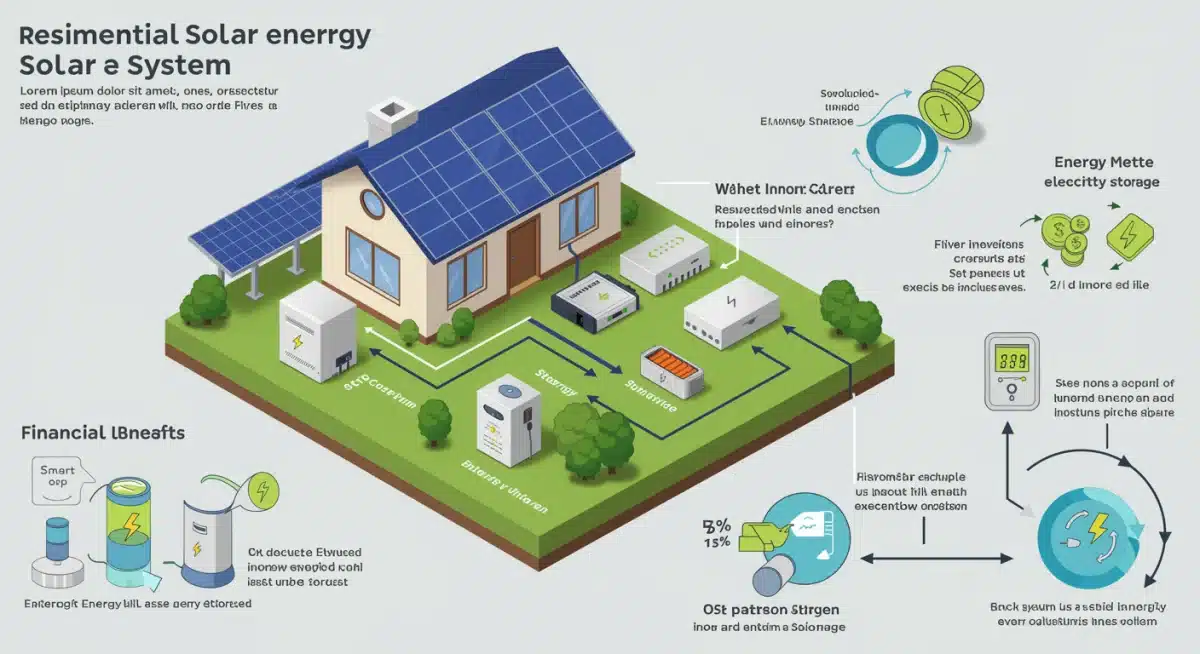
The federal ITC significantly reduces the upfront cost of solar, making it more accessible to a broader range of homeowners. Its sustained presence at 30% through 2032 provides a strong foundation for continued growth in the residential solar sector, but future decreases will necessitate adapting financial projections.
State and Local Incentive Programs: A Shifting Landscape
Beyond federal incentives and net metering, a diverse array of state and local programs play a critical role in shaping the residential solar market. For 2025, these programs are seeing continuous adjustments, offering both new opportunities and potential challenges for homeowners.
These incentives can range from direct rebates and grants to property tax exemptions and preferential loan programs. Their localized nature means that what’s available in one state or even one county can be vastly different from another, requiring careful research.
Diversity in State-Level Support
Many states offer additional financial incentives to encourage solar adoption. These can significantly enhance the ROI, especially when combined with the federal ITC. However, these programs are often subject to budget limitations, sunset clauses, or periodic revisions based on state energy goals and market saturation.
- Renewable Energy Credits (RECs): Some states allow homeowners to sell RECs generated by their solar systems, providing an additional revenue stream.
- Property Tax Exemptions: Many states exempt the value added by a solar system from property tax assessments, saving homeowners money over the system’s lifespan.
- Sales Tax Exemptions: Several states offer sales tax exemptions on solar equipment, further reducing upfront costs.
- Low-Interest Loan Programs: State-sponsored loan programs can make solar more affordable by providing access to financing with favorable terms.
The variability of these programs means that proactive research is essential. Homeowners should consult their state’s energy office or local solar installers to understand all available incentives. These programs are often designed to address specific regional challenges or promote particular technologies, such as battery storage in areas prone to power outages.
As the solar market matures, some long-standing state incentives may be phased out, while new ones emerge to address evolving energy priorities. Therefore, the 2025 outlook requires homeowners to be vigilant about the current status of these programs and to factor their potential changes into their financial calculations.
The Growing Importance of Energy Storage Solutions
With the shifts in net metering policies and the increasing frequency of extreme weather events, energy storage solutions, particularly residential battery systems, are becoming an indispensable component of a smart solar investment. In 2025, policies are increasingly aligning to support battery adoption.
Batteries allow homeowners to store excess solar energy generated during the day for use during peak demand hours or during grid outages. This capability significantly enhances energy independence and can mitigate the impact of reduced net metering compensation.
Policy Support for Battery Storage
Several states and utilities are introducing incentives specifically for battery storage, recognizing its role in grid resilience and demand management. These incentives can make the upfront cost of a battery system more manageable.
- Federal ITC Inclusion: As mentioned, the federal ITC applies to battery storage when installed in conjunction with a solar system.
- State Battery Rebates: States like California (SGIP) and Massachusetts (MOR-EV) offer direct rebates for battery storage installations.
- Virtual Power Plants (VPPs): Some utilities offer compensation for homeowners who allow their battery systems to be dispatched during grid emergencies, essentially creating a virtual power plant.
- Resilience Programs: Policies aimed at enhancing grid resilience often include provisions for residential battery deployment, sometimes with grant funding.
The integration of batteries not only provides backup power but also allows homeowners to optimize their energy consumption, taking advantage of time-of-use electricity rates. By storing energy when rates are low and discharging when rates are high, homeowners can further reduce their electricity bills.
As policy makers continue to prioritize grid modernization and renewable energy integration, expect to see continued support and innovation in the energy storage sector. For residential solar owners, a battery system in 2025 is less of a luxury and more of a strategic enhancement to their energy independence and financial ROI.
Navigating Permitting and Interconnection Challenges
While often overlooked in policy discussions, the processes of permitting and interconnecting a residential solar system to the grid present significant administrative hurdles that can impact project timelines and costs. In 2025, efforts are underway to streamline these processes, but challenges persist.
Complex or inconsistent local regulations can create bottlenecks, delaying installations and adding unexpected expenses. These administrative policies, though not direct financial incentives, indirectly affect the overall ROI by influencing project efficiency.
Streamlining Local Regulations
Many states and municipalities are recognizing the need for more uniform and efficient permitting and interconnection standards. The goal is to reduce red tape and accelerate solar deployment.
- Standardized Permitting Forms: Efforts to create universal or simplified permit applications at the state level.
- Online Permitting Portals: Digital platforms designed to expedite the application and approval process.
- Expedited Review Processes: Policies that mandate faster review times for solar permits.
- Interconnection Rule Updates: States are revising rules to make it easier and quicker for solar systems to connect to the utility grid.
The push for streamlining is driven by the desire to meet renewable energy targets and to avoid frustrating homeowners and installers. However, the pace of change varies widely, and some localities may still have outdated or cumbersome requirements. Homeowners should work with experienced solar installers who are familiar with local regulations and can navigate these processes efficiently.
Efficient permitting and interconnection are critical for a smooth solar installation experience. While policy changes in this area may not directly put money back into your pocket, they save time and reduce potential headaches, ultimately contributing to a better overall ROI through reduced soft costs and faster system activation.
The Future of Residential Solar: Beyond 2025
Looking beyond 2025, the trajectory for residential solar remains overwhelmingly positive, albeit with continuous evolution in policy and technology. The foundational shifts observed this year are setting the stage for a more mature and resilient solar market.
Innovation in panel efficiency, battery technology, and smart home energy management systems will continue to drive down costs and enhance the value proposition of solar for homeowners. Policy will likely adapt to these technological advancements, further encouraging adoption.
Anticipated Trends and Policy Directions
Several trends are expected to shape the residential solar landscape in the coming years, influencing future policy decisions and homeowner strategies.
- Increased Electrification: As homes electrify heating, cooling, and transportation, solar will become even more central to energy independence.
- Grid Modernization: Policies will continue to support smart grid technologies and distributed energy resources, including residential solar and storage.
- Community Solar Growth: Expect more robust programs for community solar, offering benefits to those unable to install panels on their own roofs.
- Focus on Equity: Policies are likely to increasingly address energy equity, ensuring solar benefits are accessible to low-income communities.
The long-term outlook suggests a continued commitment to renewable energy, driven by climate goals, energy security concerns, and technological progress. While specific incentives may change, the underlying momentum towards a solar-powered future is undeniable. Homeowners who adapt to the evolving policy landscape and embrace new technologies will be best positioned to reap the long-term rewards of residential solar.
The future of residential solar is bright, characterized by innovation, increasing integration with smart home technologies, and a policy environment that, despite its shifts, continues to support sustainable energy solutions. Staying informed and adaptable will be key to maximizing the benefits of solar power for years to come.
| Key Policy Change | Impact on ROI |
|---|---|
| Net Metering Revisions | Alters compensation for exported energy; may require battery storage for optimal savings. |
| Federal ITC Stability | Maintains 30% tax credit through 2032, significantly reducing upfront costs. |
| State/Local Incentives | Variable rebates, exemptions, and loan programs; requires local research for maximum benefit. |
| Energy Storage Support | Growing incentives for batteries enhance energy independence and mitigate policy changes. |
Frequently Asked Questions About 2025 Residential Solar
Net metering changes in 2025 will likely reduce the compensation you receive for excess electricity sent to the grid. This means your savings will depend more on self-consumption and potentially integrating battery storage to maximize the value of your generated power, rather than relying heavily on grid exports.
Yes, the federal Investment Tax Credit (ITC) remains at 30% for residential solar systems installed in 2025. This rate is secured through 2032, providing a stable and significant financial incentive for homeowners to adopt solar energy and reduce their upfront investment costs.
To find the best state-specific solar incentives for 2025, you should consult your state’s energy office website, utility company portals, or reputable local solar installers. Websites like DSIRE (Database of State Incentives for Renewables & Efficiency) are also excellent resources for comprehensive, up-to-date information.
Battery storage is crucial in 2025 due to evolving net metering policies that reduce export compensation, increasing electricity rates, and a greater need for grid resilience during outages. Batteries allow homeowners to store solar energy for self-consumption, optimize usage, and enhance energy independence.
To ensure a smooth permitting process for your 2025 solar installation, choose an experienced local solar installer familiar with your municipality’s specific regulations. They can navigate local requirements, prepare necessary documentation, and handle inspections efficiently, minimizing delays and potential complications.
Conclusion
The 2025 outlook for residential solar is defined by a dynamic interplay of federal consistency and state-level evolution. While the steadfast 30% federal Investment Tax Credit provides a robust foundation, changes in net metering policies and the variable nature of state and local incentives demand a strategic approach from homeowners. Integrating energy storage solutions is increasingly vital for maximizing ROI and enhancing energy independence. By staying informed about these key policy shifts and engaging with knowledgeable professionals, homeowners can confidently navigate the evolving landscape, ensuring their solar investment yields significant financial and environmental returns for years to come.