Bioenergy in 2026: US Policies Drive 20% Sustainable Fuel Growth

Anúncios
The global energy landscape is undergoing a monumental transformation, driven by an urgent need to mitigate climate change and achieve energy independence. Among the myriad of renewable energy sources, bioenergy stands out as a versatile and potent solution. It encompasses a broad range of technologies that convert biomass into heat, electricity, or liquid fuels. In the United States, 2026 is shaping up to be a pivotal year for the bioenergy sector, with new policies poised to catalyze a remarkable 20% increase in sustainable fuel production. This ambitious target is not merely a number; it represents a strategic pivot towards a cleaner, more secure energy future, underpinned by robust governmental support and technological innovation. The implications of these US bioenergy policies are far-reaching, promising significant environmental benefits, economic growth, and a strengthened position for the US in the global renewable energy market.
Understanding the intricacies of these forthcoming policies is crucial for anyone interested in the future of energy. From farmers growing dedicated energy crops to scientists developing advanced biorefinery technologies, and from investors seeking green opportunities to consumers looking for sustainable alternatives, the impact will be felt across all sectors. This article will delve into the specific policies driving this anticipated surge, explore the technological advancements making it possible, analyze the economic and environmental ramifications, and discuss the challenges and opportunities that lie ahead for US bioenergy policies and their impact on sustainable fuel production.
The Policy Landscape: Catalyzing Bioenergy Growth
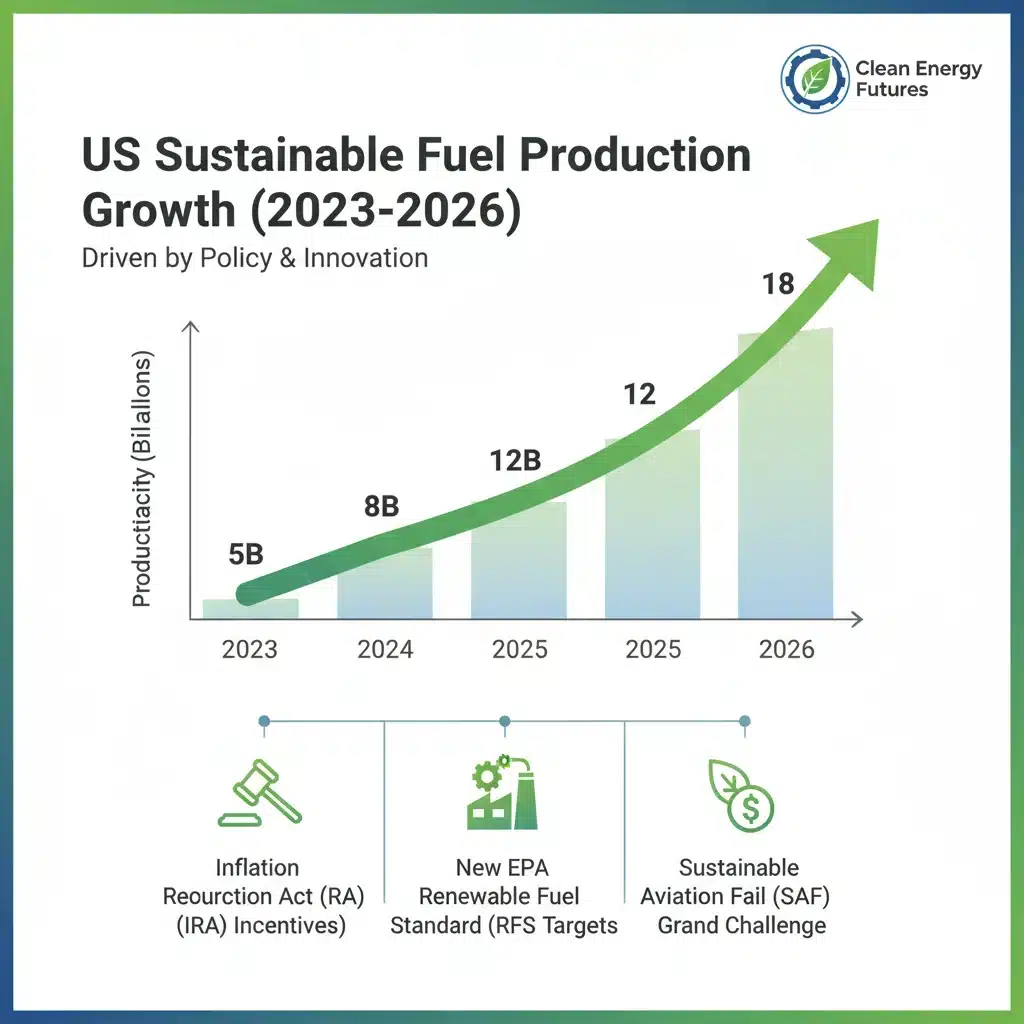
The anticipated 20% increase in sustainable fuel production by 2026 is not a spontaneous occurrence but the result of a concerted effort by the US government to promote renewable energy. Several key legislative and regulatory frameworks are converging to create an environment ripe for bioenergy expansion. These policies are designed to reduce greenhouse gas emissions, enhance energy security, and stimulate rural economic development. The primary drivers include:
Renewable Fuel Standard (RFS) Enhancements
The Renewable Fuel Standard (RFS) has been a cornerstone of US bioenergy policy since its inception. Originally established under the Energy Policy Act of 2005 and expanded by the Energy Independence and Security Act of 2007, the RFS mandates that a certain volume of renewable fuel be blended into the nation’s transportation fuel supply. For 2026, significant enhancements are expected to the RFS, particularly in setting higher renewable volume obligations (RVOs) for advanced biofuels and cellulosic biofuels. These higher mandates create a strong market signal for increased production, offering certainty to investors and developers. The focus on advanced and cellulosic biofuels is critical, as these fuels offer greater greenhouse gas reduction potential and often utilize non-food feedstocks, addressing concerns about food versus fuel competition. The EPA’s role in defining these RVOs and ensuring compliance will be central to the success of these US bioenergy policies.
Inflation Reduction Act (IRA) Incentives
The Inflation Reduction Act (IRA) of 2022 represents the largest climate investment in US history, and its provisions are set to profoundly impact the bioenergy sector. The IRA extends and expands a suite of tax credits designed to incentivize clean energy production and adoption. For bioenergy, this includes enhanced tax credits for sustainable aviation fuel (SAF), clean hydrogen production from biomass, and biomass-based diesel. The Clean Fuel Production Credit (45Z) and the Sustainable Aviation Fuel (SAF) Credit (40B) are particularly relevant. These credits provide long-term financial certainty, making bioenergy projects more attractive to investors. By significantly lowering the cost of production for sustainable fuels, the IRA aims to make them competitive with traditional fossil fuels, thus accelerating their market penetration. The IRA’s emphasis on domestic manufacturing and supply chains also supports job creation and economic development within the US bioenergy industry, further strengthening the impact of US bioenergy policies.
Department of Energy (DOE) Funding and Initiatives
The Department of Energy (DOE) plays a vital role in advancing bioenergy research, development, and demonstration. Through various programs and funding opportunities, the DOE supports innovative technologies that can convert diverse biomass feedstocks into valuable fuels and products. For 2026, increased funding is anticipated for projects focusing on waste-to-energy conversion, algal biofuels, and sustainable biomass supply chain optimization. The DOE’s Bioenergy Technologies Office (BETO) is instrumental in these efforts, collaborating with national laboratories, universities, and private industry to overcome technical barriers and scale up promising technologies. These initiatives are crucial for ensuring that the US has the technological capabilities to meet the ambitious production targets set by the new US bioenergy policies.
State-Level Policies and Regional Initiatives
Beyond federal mandates, several states are implementing their own aggressive renewable energy policies and incentives that complement national efforts. California’s Low Carbon Fuel Standard (LCFS) is a prime example, creating a market for low-carbon fuels and driving innovation in bioenergy. Other states are exploring similar mechanisms, alongside grants, tax incentives, and streamlined permitting processes for bioenergy facilities. Regional collaborations, such as those focused on developing sustainable aviation fuel hubs, also contribute significantly to the overall growth. The synergy between federal and state policies creates a robust framework that encourages investment and deployment of bioenergy technologies across the nation, reinforcing the effectiveness of US bioenergy policies.
Technological Advancements: The Engine of Growth
Achieving a 20% increase in sustainable fuel production requires not only supportive policies but also continuous technological innovation. The bioenergy sector is dynamic, with ongoing research and development leading to more efficient, cost-effective, and sustainable conversion pathways. These advancements are critical for expanding the range of usable feedstocks, improving conversion efficiencies, and reducing the environmental footprint of bioenergy production.
Advanced Biorefining Processes
Traditional first-generation biofuels primarily rely on food crops like corn (for ethanol) and soybeans (for biodiesel). While these have played a role in kickstarting the industry, the future of bioenergy lies in advanced biorefining processes that utilize non-food feedstocks. These include agricultural residues (corn stover, wheat straw), forestry waste, municipal solid waste, industrial waste gases, and dedicated energy crops (switchgrass, miscanthus, poplar). Technologies like pyrolysis, gasification, hydrothermal liquefaction, and biochemical conversion (e.g., enzymatic hydrolysis and fermentation) are becoming more sophisticated, allowing for the efficient breakdown of complex biomass into biofuels and bioproducts. These processes are not only more sustainable but also offer greater flexibility in feedstock choice, reducing competition with food production and diversifying supply chains.
Sustainable Aviation Fuel (SAF) Innovations
Sustainable Aviation Fuel (SAF) is a critical component of the broader bioenergy strategy, especially given the aviation sector’s significant carbon footprint and difficulty in decarbonizing. Innovations in SAF production are accelerating, with various pathways being explored. These include alcohol-to-jet (ATJ), Fischer-Tropsch (FT) synthesis, and hydroprocessed esters and fatty acids (HEFA). The goal is to produce ‘drop-in’ fuels that can be used in existing aircraft engines and infrastructure without modification. Research is focusing on developing new catalysts, optimizing reaction conditions, and utilizing novel feedstocks to produce SAF at scale and at a competitive price. The aggressive targets set by US bioenergy policies for SAF production are driving significant investment and innovation in this area.
Algal Biofuels and Other Novel Feedstocks
Algae represent a promising third-generation feedstock for biofuels, capable of high oil yields and rapid growth without competing for arable land or fresh water (many species thrive in wastewater or saltwater). Advances in cultivation techniques, harvesting methods, and lipid extraction are bringing algal biofuels closer to commercial viability. Similarly, research into other novel feedstocks, such as industrial CO2 emissions converted into fuels via microbial processes, is expanding the potential resource base for bioenergy. These cutting-edge technologies, supported by US bioenergy policies, are crucial for long-term sustainability and scalability.
Carbon Capture and Utilization (CCU) Integration
To further enhance the environmental benefits of bioenergy, integration with carbon capture and utilization (CCU) technologies is gaining traction. Bioenergy with Carbon Capture and Storage (BECCS) can result in net negative emissions, as biomass absorbs CO2 during growth, and the CO2 released during conversion is captured and stored. While BECCS faces its own set of challenges, advances in CCU are making it more economically feasible to capture CO2 from bioenergy facilities and utilize it in other industrial processes or for enhanced oil recovery. This integration positions bioenergy as a key player in achieving ambitious climate goals, aligning perfectly with the objectives of the new US bioenergy policies.
Economic and Environmental Impacts
The projected 20% increase in sustainable fuel production by 2026, driven by robust US bioenergy policies, is expected to yield substantial economic and environmental benefits. These impacts extend beyond merely reducing carbon emissions, touching upon job creation, rural development, energy security, and improved air quality.
Job Creation and Rural Economic Development
The expansion of the bioenergy sector is a significant engine for economic growth, particularly in rural areas. From farmers growing energy crops and foresters managing sustainable biomass resources to workers involved in the construction and operation of biorefineries, the industry creates a diverse range of jobs. These jobs often require specialized skills, fostering local expertise and providing stable employment. The development of new bioenergy facilities stimulates local economies through increased tax revenues, demand for local services, and investment in infrastructure. This economic revitalization is a key objective of many US bioenergy policies, aiming to create a more resilient and equitable economy.
Reduced Greenhouse Gas Emissions
Perhaps the most direct and impactful environmental benefit of increased bioenergy production is the reduction in greenhouse gas (GHG) emissions. Sustainable biofuels, especially advanced and cellulosic varieties, can significantly lower the lifecycle carbon footprint compared to fossil fuels. By displacing gasoline and diesel in transportation, and coal or natural gas in power generation, bioenergy contributes directly to national and international climate targets. The emphasis on sustainable feedstock sourcing and efficient conversion technologies ensures that these reductions are real and measurable, supporting the overarching climate goals embedded in US bioenergy policies.
Enhanced Energy Security
Reliance on imported fossil fuels exposes nations to geopolitical risks and price volatility. By expanding domestic bioenergy production, the US can enhance its energy independence and security. Bioenergy utilizes domestically available resources, reducing the need for foreign oil and gas. This diversification of the energy supply chain makes the nation less vulnerable to global energy market fluctuations and disruptions. The strategic importance of this aspect cannot be overstated, making energy security a core tenet of current US bioenergy policies.
Improved Air Quality
Beyond greenhouse gases, the combustion of fossil fuels contributes to local air pollution, including particulate matter, sulfur oxides, and nitrogen oxides, which have detrimental effects on human health. While bioenergy combustion also produces emissions, advanced biofuels and modern bioenergy technologies are generally designed to have lower levels of these harmful pollutants compared to their fossil fuel counterparts. Increased adoption of sustainable fuels can therefore lead to improved air quality in urban and industrial areas, offering public health benefits that complement climate action, reflecting the holistic approach of US bioenergy policies.
Waste Management Solutions
Many bioenergy technologies are capable of utilizing various waste streams as feedstocks, including municipal solid waste, agricultural residues, and industrial byproducts. This provides a valuable solution for waste management, diverting materials from landfills and reducing associated environmental problems such as methane emissions. Converting waste into energy not only reduces pollution but also creates economic value from what would otherwise be considered a disposal burden. This circular economy approach is a growing focus within the framework of US bioenergy policies.
Challenges and Opportunities
While the outlook for US bioenergy in 2026 is overwhelmingly positive, driven by supportive policies and technological progress, the path forward is not without its challenges. Addressing these hurdles will be critical to fully realizing the potential of a 20% increase in sustainable fuel production.
Feedstock Availability and Sustainability
Ensuring a consistent and sustainable supply of biomass feedstock is paramount. While the US has abundant agricultural and forestry resources, scaling up production to meet increased demand requires careful planning and management. Concerns about land use change, biodiversity impacts, and competition with food production must be addressed through sustainable sourcing practices and certifications. Research into dedicated energy crops that can thrive on marginal lands without displacing food crops is essential. The development of robust supply chains, including efficient collection, storage, and transportation of biomass, is also a critical logistical challenge that needs to be overcome, and is a major focus of US bioenergy policies.

Technological Scale-Up and Commercialization
Many advanced bioenergy technologies have demonstrated success at the laboratory or pilot scale but face significant hurdles in scaling up to commercial production. The capital costs associated with building large-scale biorefineries can be substantial, and the technical risks are higher for nascent technologies. Bridging the ‘valley of death’ between research and commercial deployment requires sustained investment, supportive financing mechanisms, and robust public-private partnerships. The incentives provided by US bioenergy policies, such as tax credits and grant programs, are vital for de-risking these investments and accelerating commercialization.
Infrastructure Development
The existing energy infrastructure is largely designed for fossil fuels. Integrating new sustainable fuels into this system requires significant investment in infrastructure upgrades, including pipelines, storage facilities, and dispensing stations. For example, while SAF can be ‘drop-in,’ ensuring its widespread availability at airports requires a dedicated distribution network. Similarly, expanding the use of renewable natural gas (RNG) in vehicles and heating systems necessitates upgrades to gas pipelines and fueling stations. Coordinating these infrastructure developments with production increases is a complex undertaking that will require careful planning and collaboration across industries, a challenge being addressed by current US bioenergy policies.
Public Perception and Acceptance
Despite the environmental benefits, bioenergy sometimes faces public scrutiny, particularly concerning land use, water consumption, and the ‘food versus fuel’ debate. Effective communication and public education are crucial to building understanding and acceptance of sustainable bioenergy practices. Demonstrating the tangible benefits – such as reduced emissions, local job creation, and improved waste management – can help foster a more positive perception. Transparency in reporting environmental impacts and engaging with local communities are also key to gaining social license for new projects, an aspect that progressive US bioenergy policies are increasingly emphasizing.
The Road Ahead: A Sustainable Future
The commitment to achieving a 20% increase in sustainable fuel production by 2026 through strategic US bioenergy policies marks a significant milestone in the nation’s journey towards a sustainable energy future. This ambitious goal reflects a growing understanding of bioenergy’s multifaceted benefits – from climate change mitigation and energy security to economic development and waste valorization. The confluence of enhanced policy support, continuous technological innovation, and increasing private sector investment is creating an unprecedented opportunity for the bioenergy sector to flourish.
Looking beyond 2026, the trajectory for bioenergy in the US is one of continued growth and diversification. Further advancements in feedstock development, conversion technologies, and integrated biorefineries will unlock even greater potential. The lessons learned from scaling up production in the coming years will inform future policies and strategies, ensuring that bioenergy remains a dynamic and integral part of the nation’s clean energy portfolio. The collaborative efforts between government, industry, academia, and local communities will be essential in overcoming remaining challenges and fully harnessing the power of biomass to fuel a greener, more prosperous future. The impact of these forward-thinking US bioenergy policies will resonate for decades, setting a precedent for sustainable energy development worldwide.
In conclusion, the vision for 2026 is not just about meeting a production target; it’s about solidifying the US’s leadership in renewable energy, fostering innovation, and building a resilient energy system that benefits all Americans. The proactive stance taken through comprehensive US bioenergy policies is paving the way for a bioenergy revolution, transforming how we power our homes, industries, and transportation, and bringing us closer to a truly sustainable world.