Maximize Savings: 2026 Energy Storage Tax Credits Explained
Anúncios
In an era defined by a relentless pursuit of sustainability and energy independence, the adoption of energy storage systems has emerged as a cornerstone of modern infrastructure. From residential homes seeking to harness solar power efficiently to commercial enterprises optimizing their energy consumption, battery storage solutions are revolutionizing how we interact with the grid. However, the initial investment in these advanced systems can often be a significant hurdle. This is where the energy storage tax credits, particularly the Investment Tax Credit (ITC), play a pivotal role, offering substantial financial incentives that can dramatically reduce your system cost by up to 30% or even more.
As we approach 2026, understanding the nuances of these tax credits becomes not just beneficial, but essential for anyone considering investing in energy storage. The landscape of renewable energy incentives is dynamic, and staying informed about the latest provisions can unlock unparalleled savings. This comprehensive guide will delve deep into the 2026 ITC for energy storage, explaining its mechanisms, eligibility requirements, and the profound financial impact it can have on your investment. Our goal is to equip you with the knowledge needed to navigate these incentives effectively, ensuring you maximize your financial returns while contributing to a more sustainable future.
Understanding the Investment Tax Credit (ITC) for Energy Storage
The Investment Tax Credit (ITC) is a federal incentive that has been instrumental in driving the growth of renewable energy in the United States. While historically associated primarily with solar photovoltaic (PV) systems, the scope of the ITC has expanded significantly to include standalone energy storage systems. This expansion recognizes the critical role that battery storage plays in grid stability, energy resilience, and the effective integration of intermittent renewable energy sources.
At its core, the ITC allows individuals and businesses to claim a percentage of the cost of eligible energy property as a credit against their federal income taxes. For energy storage systems placed in service after 2022, the base credit amount is 30% of the eligible project costs. This is not a deduction; it’s a dollar-for-dollar reduction in your tax liability, making it an incredibly powerful incentive.
The Evolution of ITC and Its Inclusion of Energy Storage
Initially, energy storage qualified for the ITC only when charged by an on-site renewable energy source, such as solar panels. This meant that a standalone battery system not directly coupled with solar generation would not be eligible. However, the Inflation Reduction Act (IRA) of 2022 brought about a transformative change. The IRA explicitly made standalone energy storage systems eligible for the ITC, provided they meet certain criteria.
This legislative update was a game-changer, removing a significant barrier to entry for many potential energy storage adopters. It acknowledged that energy storage, irrespective of its charging source, provides substantial benefits to the grid and consumers. This means that even if you’re installing a battery system purely for demand charge management, backup power, or arbitrage, you can still qualify for the lucrative energy storage tax credits.
Key Provisions for 2026: What to Expect
As we look towards 2026, the foundational structure of the ITC as established by the IRA is expected to remain largely consistent. The 30% base credit is a significant benefit, but it’s important to understand that this percentage can be influenced by various factors, including project size, location, and adherence to specific labor and domestic content requirements. The IRA introduced ‘adders’ to the base ITC, which can increase the credit beyond 30%.
- Base Credit (30%): Applicable to eligible energy storage systems.
- Domestic Content Adder: Projects that meet certain domestic content requirements (e.g., a specified percentage of manufactured components produced in the U.S.) can receive an additional 10% credit.
- Energy Community Adder: Projects located in designated ‘energy communities’ (areas historically reliant on fossil fuel industries) can also qualify for an additional 10% credit.
- Low-Income Community Adder: Projects serving low-income communities or benefiting low-income households may qualify for additional credits (typically 10% or 20%).
These adders mean that a project could potentially achieve an ITC of 40%, 50%, or even 70% in certain highly specific circumstances. While reaching the maximum percentage might be challenging for many, understanding these additional incentives is crucial for maximizing your financial benefits from energy storage tax credits.
Eligibility Requirements for 2026 Energy Storage Tax Credits
To successfully claim the energy storage tax credits, both individuals and businesses must ensure their systems meet specific eligibility criteria. These criteria are designed to ensure that the incentivized systems contribute effectively to the nation’s energy goals and are deployed responsibly.
Defining ‘Eligible Energy Storage Technology’
The IRS defines eligible energy storage technology as property which stores energy for conversion to electricity or that stores thermal energy for use in a structure. For battery storage systems, the key criterion is a capacity of at least 5 kilowatt-hours (kWh). This threshold applies to both residential and commercial installations, ensuring that only systems with a meaningful storage capacity qualify for the credit.
It’s important to note that the energy storage system must be new construction or the first use of the property. Used equipment typically does not qualify. The system must also be installed in the United States.
Residential vs. Commercial Eligibility
The ITC applies to both residential and commercial projects, though the application and implications can differ slightly:
- Residential Systems: Homeowners installing battery storage systems (either standalone or paired with solar) can claim the ITC on their personal income taxes. The system must be installed in a home located in the U.S. and used as a residence by the taxpayer. The credit is non-refundable, meaning it can reduce your tax liability to zero, but you won’t get a refund for any excess credit. However, any unused credit can be carried forward to future tax years.
- Commercial Systems: Businesses, including corporations, partnerships, and other entities, can also claim the ITC for eligible energy storage systems. For commercial projects, there are additional considerations related to depreciation and the ‘elective pay’ (direct pay) and ‘transferability’ provisions introduced by the IRA. These provisions allow certain tax-exempt entities and state/local governments to receive the credit as a direct payment, or for eligible for-profit entities to sell their tax credits to other taxpayers, enhancing project financing options.
Key Dates and ‘Placed in Service’ Rules
For the 2026 ITC, the system must be ‘placed in service’ during the tax year for which the credit is claimed. ‘Placed in service’ generally means the system is fully installed, operational, and ready for its intended use. It’s not just about when you purchase the equipment, but when it’s actively contributing to your energy needs.
The current 30% base rate for the ITC is scheduled to remain in effect until 2032, after which it is slated to step down. This extended certainty provides a stable incentive environment for planning and investment in energy storage tax credits.
Calculating Your Savings: How the 30% Credit Works
The core appeal of the energy storage tax credits lies in their ability to directly reduce the financial burden of installing a battery storage system. Understanding how to calculate your potential savings is crucial for making informed decisions.
Understanding ‘Eligible Project Costs’
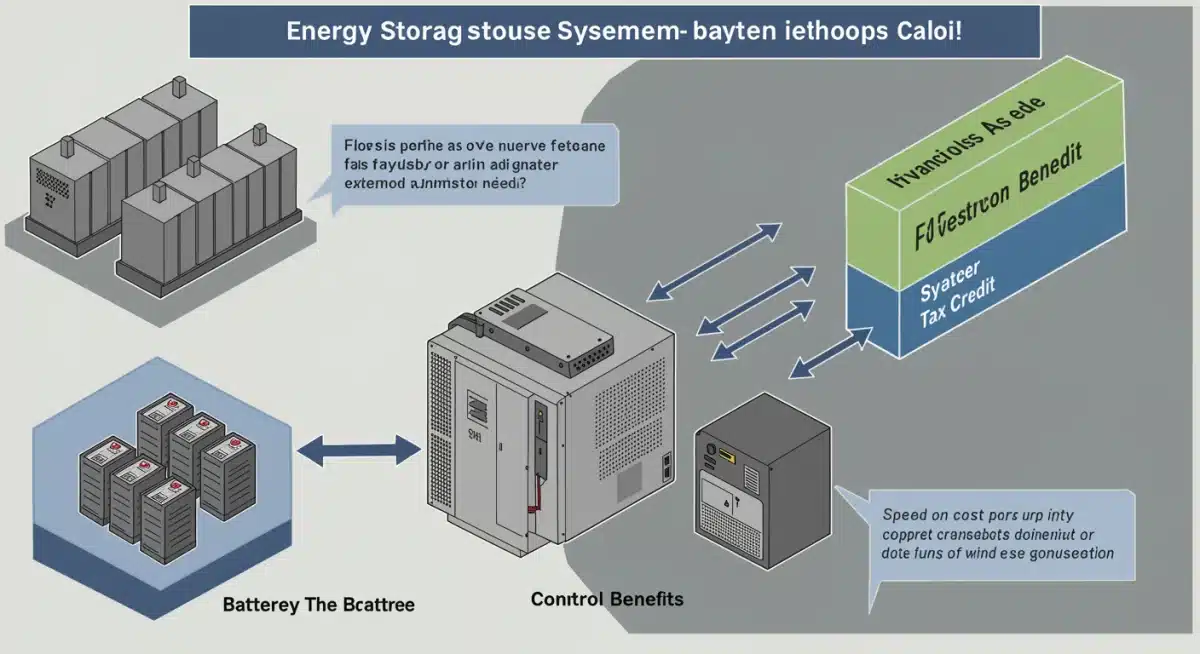
The 30% (or higher, with adders) credit is applied to the ‘eligible project costs.’ This typically includes:
- The cost of the energy storage equipment itself (batteries, inverters, control systems).
- Labor costs for on-site preparation, assembly, and installation.
- Permitting and inspection fees.
- Designer fees for system design.
It generally does not include financing fees, land costs, or certain operational expenses. It’s vital to keep meticulous records of all project-related expenditures to accurately claim the credit.
Scenario 1: Residential Energy Storage System
Let’s consider a homeowner installing a standalone battery storage system with eligible costs totaling $15,000. Assuming they qualify for the base 30% ITC:
- Total Eligible Cost: $15,000
- ITC Rate: 30%
- Tax Credit Amount: $15,000 * 0.30 = $4,500
This means the homeowner can reduce their federal income tax liability by $4,500. If their tax liability for the year is $5,000, they would only owe $500. If their tax liability is $3,000, it would be reduced to $0, and the remaining $1,500 in credit could be carried forward to the next tax year.
Scenario 2: Commercial Energy Storage System with Adders
Imagine a commercial entity installing a large-scale battery storage system with eligible costs of $500,000. This project meets the domestic content requirements and is located in an ‘energy community’.
- Total Eligible Cost: $500,000
- Base ITC Rate: 30%
- Domestic Content Adder: +10%
- Energy Community Adder: +10%
- Total ITC Rate: 50%
- Tax Credit Amount: $500,000 * 0.50 = $250,000
In this scenario, the business would receive a $250,000 reduction in its federal tax liability, drastically lowering the net cost of the system. For commercial entities, the ability to utilize elective pay or transferability for these large credits further enhances the financial viability of such projects.
Understanding the Financial Impact and ROI
The energy storage tax credits directly impact the Return on Investment (ROI) of your system. By reducing the upfront cost, the payback period for your investment shortens, and the overall financial benefits increase. Consider the benefits:
- Reduced Upfront Cost: The most immediate benefit, making advanced energy storage more accessible.
- Accelerated Payback Period: Lower net cost means you recoup your investment faster through energy bill savings, demand charge reductions, and potential revenue from grid services.
- Enhanced Project Viability: For commercial projects, the ITC can be the determining factor in whether a project is financially feasible.
- Increased Property Value: For residential properties, an installed energy storage system can increase home value, particularly in areas prone to power outages.
Navigating the Application Process for 2026 ITC
While the financial benefits of the energy storage tax credits are substantial, successfully claiming them requires careful attention to the application process. Understanding the necessary steps and documentation will ensure a smooth experience.
Required Documentation and Forms
For individuals, claiming the residential clean energy credit (which includes energy storage) typically involves filing IRS Form 5695, ‘Residential Clean Energy Credit,’ with your federal income tax return. You will need to itemize the eligible costs of your energy storage system. Keep detailed records of all invoices, receipts, and contracts related to the purchase and installation of your system.
For businesses, the process is more complex and usually involves IRS Form 3468, ‘Investment Credit.’ Depending on the business structure and how the credit is utilized (e.g., direct pay or transferability), additional forms and specific reporting requirements may apply. It is highly recommended that businesses consult with a tax professional experienced in renewable energy credits.
Tips for a Smooth Claim Process
- Keep Meticulous Records: This cannot be stressed enough. Every expense related to the eligible project costs should be documented. This includes purchase receipts for equipment, contractor invoices for labor, and any permit fees.
- Work with Reputable Installers: Choose installers who are knowledgeable about the ITC and can provide accurate documentation of eligible costs. They often have experience guiding customers through the process.
- Consult a Tax Professional: Especially for commercial projects or complex residential situations, a tax advisor specializing in renewable energy incentives can be invaluable. They can help ensure compliance, identify all applicable credits (including state and local incentives), and optimize your claim.
- Understand ‘Placed in Service’ Dates: Ensure your system is fully operational and ready for use within the tax year you plan to claim the credit.
- Stay Informed: Tax laws and interpretations can change. Regularly check IRS guidelines or consult your tax professional for any updates regarding energy storage tax credits.
Common Pitfalls to Avoid
- Incorrect Cost Allocation: Misattributing costs that are not eligible for the credit can lead to audits and penalties.
- Missing Documentation: Lack of proper invoices or proof of payment is a common reason for denied claims.
- Misunderstanding Adders: Incorrectly claiming adders (e.g., domestic content, energy community) without meeting strict criteria can complicate your tax filing.
- Ignoring State/Local Incentives: Focusing solely on the federal ITC can mean missing out on valuable state or local rebates and tax credits that can further reduce your costs.
Beyond the Federal ITC: Other Financial Incentives
While the federal energy storage tax credits are a cornerstone of financial support, they are not the only incentives available. A layered approach, combining federal, state, and local programs, can lead to even greater savings and accelerate your return on investment.
State and Local Rebates and Tax Credits
Many states and municipalities offer their own incentive programs for energy storage. These can include:
- State Tax Credits: Similar to the federal ITC, some states provide their own income tax credits for renewable energy and energy storage installations.
- Rebate Programs: State or utility-sponsored rebates offer a direct cash payment for installing eligible systems. These can significantly reduce the upfront cost. Examples include programs in California (SGIP), Massachusetts (SMART), and New York (NYSERDA).
- Property Tax Exemptions: Some jurisdictions offer exemptions or reductions in property taxes for homes or businesses that install renewable energy systems, including storage.
- Sales Tax Exemptions: A few states exempt energy storage equipment from sales tax, providing immediate savings on the purchase.
It’s crucial to research the specific programs available in your area, as they can vary widely and often have their own eligibility requirements and application processes. Combining these local incentives with the federal ITC can lead to substantial reductions in your net system cost.
Utility Programs and Grid Services
Utilities are increasingly recognizing the value of distributed energy storage for grid stability and demand management. Many offer programs that incentivize customers to install storage and even participate in grid services:
- Demand Response Programs: These programs pay customers to reduce their electricity consumption (or discharge their batteries) during peak demand periods, helping to balance the grid and avoid costly infrastructure upgrades.
- Virtual Power Plants (VPPs): Aggregators can link multiple distributed energy storage systems into a ‘virtual power plant’ that can provide services to the grid, such as frequency regulation or capacity reserves, generating revenue for participants.
- Time-of-Use (TOU) Rates: While not a direct incentive, TOU rates encourage the use of energy storage by making electricity cheaper during off-peak hours and more expensive during peak hours. Batteries can charge during off-peak times and discharge during peak times, leading to significant bill savings.
Engaging with your local utility to understand their specific programs can add another layer of financial benefit to your energy storage investment, further leveraging the impact of energy storage tax credits.
The Broader Benefits of Energy Storage Investment
While the financial incentives provided by energy storage tax credits are a compelling driver, the decision to invest in energy storage extends beyond mere cost savings. The benefits ripple through various aspects of personal and commercial operations, contributing to a more resilient, sustainable, and independent energy future.
Enhanced Energy Resilience and Backup Power
One of the most immediate and tangible benefits of an energy storage system is enhanced energy resilience. In an era of increasing climate-related disruptions and aging grid infrastructure, power outages are becoming more frequent and prolonged. A battery storage system, especially when paired with solar, provides reliable backup power, ensuring your home or business remains operational when the grid goes down. This peace of mind is invaluable, protecting critical systems, preventing data loss, and maintaining comfort and safety.
Optimized Energy Management and Cost Savings
Beyond the tax credits, energy storage empowers you to take control of your energy consumption and costs. For homeowners, this means storing excess solar energy generated during the day for use at night, reducing reliance on grid electricity and maximizing self-consumption. For businesses, this translates into significant savings through demand charge management, where batteries discharge during peak demand periods to avoid high utility charges. Energy arbitrage, buying electricity when it’s cheap and selling/using it when it’s expensive, is another powerful cost-saving strategy enabled by storage.
Environmental Impact and Sustainability Goals
Investing in energy storage is a direct contribution to environmental sustainability. By enabling greater integration of renewable energy sources and reducing reliance on fossil fuel-generated electricity, battery storage helps lower carbon emissions and combat climate change. For businesses, this aligns with corporate social responsibility (CSR) goals and can enhance brand image. For individuals, it’s a personal step towards a greener lifestyle and a healthier planet. The energy storage tax credits make this environmental commitment more financially accessible.
Contributing to Grid Stability and Modernization
Every energy storage system, whether residential or commercial, plays a role in modernizing and stabilizing the electricity grid. Distributed energy resources like batteries can provide essential grid services, such as frequency regulation and voltage support, helping utilities manage the influx of variable renewable energy. By reducing peak demand, storage systems also alleviate strain on grid infrastructure, potentially delaying or avoiding the need for costly upgrades to traditional power plants and transmission lines.
Looking Ahead: The Future of Energy Storage Incentives
The current landscape of energy storage tax credits is robust, but the future holds even more potential as technology evolves and policy adapts to changing energy needs. The long-term stability of the ITC provides a strong foundation, yet ongoing developments are worth monitoring.
Potential Policy Changes and Extensions
While the ITC for energy storage is set to continue at 30% through 2032, policy discussions are always ongoing. Advocates for renewable energy and storage continuously push for extensions, enhancements, and new incentives to accelerate the clean energy transition. Staying informed about legislative developments at both federal and state levels is important, as future changes could offer even greater opportunities for savings or impact eligibility criteria.
Technological Advancements in Battery Storage
The energy storage industry is characterized by rapid technological innovation. Advances in battery chemistry, manufacturing processes, and system integration are leading to:
- Lower Costs: As production scales and technology matures, the cost of battery storage continues to decline, making systems more affordable even before incentives.
- Improved Performance: Batteries are becoming more efficient, with higher energy density, longer lifespans, and faster charging capabilities.
- Enhanced Safety: Ongoing research and development are improving the safety profiles of battery storage systems.
These technological advancements, combined with stable energy storage tax credits, create a powerful synergy that makes investing in storage increasingly attractive and financially viable.
The Growing Role of Energy Storage in the Grid
Energy storage is no longer just a niche accessory to solar panels; it is becoming an indispensable component of a resilient, decarbonized, and intelligent grid. As more renewable energy comes online, the need for flexible storage solutions will only grow. This increasing demand is likely to foster continued policy support and innovation in the sector, ensuring that incentives like the ITC remain a key part of the energy transition strategy.
Conclusion: Seizing the Opportunity with 2026 Energy Storage Tax Credits
The 2026 Investment Tax Credit for energy storage represents a monumental opportunity for both residential and commercial entities to invest in a sustainable, resilient, and cost-effective energy future. By offering a substantial 30% (and potentially more) reduction in system costs, these energy storage tax credits transform what might seem like a significant upfront investment into a financially savvy decision with rapid returns.
From enhancing your energy independence and providing crucial backup power to contributing to environmental sustainability and grid modernization, the benefits of energy storage extend far beyond financial savings. However, leveraging these benefits effectively hinges on a clear understanding of the ITC’s eligibility requirements, application process, and how it integrates with other available incentives.
We encourage you to take proactive steps: research the specific incentives applicable to your situation, consult with qualified energy professionals and tax advisors, and meticulously plan your energy storage project. By doing so, you can unlock the full potential of these powerful financial tools, significantly reduce your system cost, and confidently move towards a more secure and sustainable energy landscape. Don’t let this opportunity pass you by – the time to invest in energy storage, empowered by generous tax credits, is now.