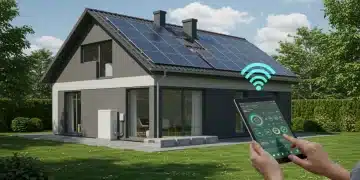
Residential Battery Sizing for 48-Hour Backup: 2026 Guide
Anúncios
In an increasingly unpredictable world, the concept of home energy independence has shifted from a niche interest to a mainstream necessity. Power outages, whether due to severe weather, grid instability, or unforeseen events, can disrupt daily life and pose significant challenges. For many homeowners, the dream of a resilient, self-sufficient home is becoming a tangible goal, and at the heart of this ambition lies the strategic implementation of residential battery storage systems. This comprehensive 2026 guide is designed to empower you with the knowledge and practical tools needed for effective residential battery sizing, specifically focusing on achieving a robust 48-hour backup power capability.
The ability to sustain your home’s essential functions for two full days without relying on the grid offers unparalleled peace of mind. It means your refrigerator keeps running, your lights stay on, your communication devices remain charged, and your heating or cooling systems can maintain comfort. But how exactly do you determine the right size battery for such a critical need? This isn’t a one-size-fits-all answer. It requires a detailed understanding of your household’s energy consumption, a grasp of various battery technologies, and a methodical approach to calculation. As we navigate through 2026, advancements in battery technology, smart home integration, and energy management systems are making this goal more attainable and efficient than ever before.
Our journey will cover everything from understanding your energy profile to the latest in battery chemistry, inverter considerations, and the often-overlooked aspects of system installation and maintenance. By the end of this guide, you will be equipped to make informed decisions about your home’s energy future, ensuring you select a battery system that not only meets your 48-hour backup requirement but also aligns with your long-term energy independence goals. Let’s embark on this essential exploration of residential battery sizing and secure your home’s power resilience.
Understanding Your Home’s Energy Profile: The First Step in Residential Battery Sizing
Before you can even begin to think about specific battery capacities, the absolute first step in effective residential battery sizing is to gain a deep understanding of your home’s energy consumption. This isn’t just about looking at your monthly electricity bill; it’s about dissecting where and how energy is used within your household, especially during a power outage scenario.
Analyzing Your Average Daily Consumption
Start by reviewing past electricity bills, ideally over a full year, to understand your average daily kilowatt-hour (kWh) consumption. Most utility bills provide this data. This gives you a baseline, but remember, this average includes all your normal usage, not just what you’d consider essential during an outage.
Identifying Essential Loads for 48-Hour Backup
The core of residential battery sizing for backup involves distinguishing between essential and non-essential loads. During a 48-hour outage, you won’t need to power everything. Create a list of appliances and systems you deem critical:
- Refrigeration: Essential for food preservation. Note its wattage and how often its compressor cycles.
- Lighting: Prioritize LED lighting in key areas.
- Communication: Routers, modems, charging for phones, laptops.
- Medical Devices: Any life-sustaining equipment must be accounted for.
- Heating/Cooling (Selective): A furnace fan or a small portable AC unit, rather than a whole-house HVAC. Consider critical rooms only.
- Water Pump: If you rely on well water.
- Garage Door Opener: For essential access.
Calculating Individual Appliance Wattage and Usage Time
For each essential item, you need two pieces of information: its wattage (how much power it draws when running) and how many hours per day it will run during the 48-hour backup period. You can often find wattage on appliance labels or in owner’s manuals. If not, a Kill-A-Watt meter can provide accurate readings.
Let’s take an example:
- Refrigeration: 150W (running) x 8 hours/day (compressor cycling) = 1200 Wh/day (1.2 kWh/day)
- LED Lights (5 bulbs): 10W each x 5 bulbs x 4 hours/day = 200 Wh/day (0.2 kWh/day)
- Router/Modem: 20W x 24 hours/day = 480 Wh/day (0.48 kWh/day)
- Phone Charging: 10W x 2 hours/day = 20 Wh/day (0.02 kWh/day)
- Well Pump: 1000W x 0.5 hours/day = 500 Wh/day (0.5 kWh/day)
Summing Your Daily Essential Load
Add up the daily Wh (or kWh) for all your essential appliances. This sum represents your projected daily essential energy consumption during an outage. For our example, let’s say it totals 5 kWh per day.
Factoring in Surge Loads and Peak Demand
While average daily consumption is crucial, you also need to consider surge loads. Some appliances, like refrigerators, well pumps, or microwaves, draw significantly more power for a brief moment when they start up. Your battery system, particularly the inverter, must be able to handle these peak demands simultaneously. Make a note of the highest wattage appliance you might run, and if multiple high-wattage items could start at once, sum their peak wattages.
By meticulously documenting your essential loads and their consumption patterns, you lay the foundational groundwork for accurate residential battery sizing. This detailed analysis ensures that your chosen battery system will genuinely meet your household’s needs during those critical 48 hours.
Calculating Your 48-Hour Battery Capacity Requirement
With your essential daily energy consumption quantified, the next critical step in residential battery sizing is to translate that into a specific battery capacity. This involves a straightforward calculation, but also important considerations like depth of discharge and system efficiency.
The Basic Calculation
If your essential daily load is, for instance, 5 kWh, and you need 48 hours (2 days) of backup, the initial calculation is simple:
Total Energy Needed (kWh) = Daily Essential Load (kWh/day) x Number of Backup Days
So, for our example: 5 kWh/day x 2 days = 10 kWh
This 10 kWh represents the raw energy you need to draw from the battery over 48 hours.
Factoring in Depth of Discharge (DoD)
Batteries perform best and last longest when they are not fully depleted. The Depth of Discharge (DoD) specifies the percentage of the battery’s capacity that has been discharged. For most modern lithium-ion batteries, a DoD of 80-90% is common and recommended. This means if you have a 10 kWh battery, you might only want to use 8 kWh (80% DoD) of its capacity to prolong its lifespan. For lead-acid batteries, DoD is typically much lower, often 50%.
To account for DoD in your residential battery sizing, you need to adjust your required capacity:
Usable Battery Capacity Required (kWh) = Total Energy Needed (kWh) / Recommended DoD (as a decimal)
Using our 10 kWh example and assuming an 80% DoD for a lithium-ion battery:
Usable Battery Capacity Required = 10 kWh / 0.80 = 12.5 kWh
This means you’d ideally want a battery system with a nominal capacity of at least 12.5 kWh to comfortably provide 10 kWh of usable energy over 48 hours while maintaining battery health.
Considering System Efficiency Losses
No energy conversion is 100% efficient. When energy flows from your battery, through an inverter (which converts DC battery power to AC household power), and into your appliances, there are always some losses. These losses can range from 10-15% for a typical battery storage system.
To account for these losses, you’ll need to further increase your required battery capacity:
Actual Battery Capacity Needed (kWh) = Usable Battery Capacity Required (kWh) / System Efficiency (as a decimal)
Assuming a system efficiency of 90% (0.90):
Actual Battery Capacity Needed = 12.5 kWh / 0.90 = 13.89 kWh
So, for our initial 5 kWh/day essential load over 48 hours, with 80% DoD and 90% system efficiency, you would be looking at a battery system with a nominal capacity of approximately 14 kWh.
Don’t Forget Inverter Sizing
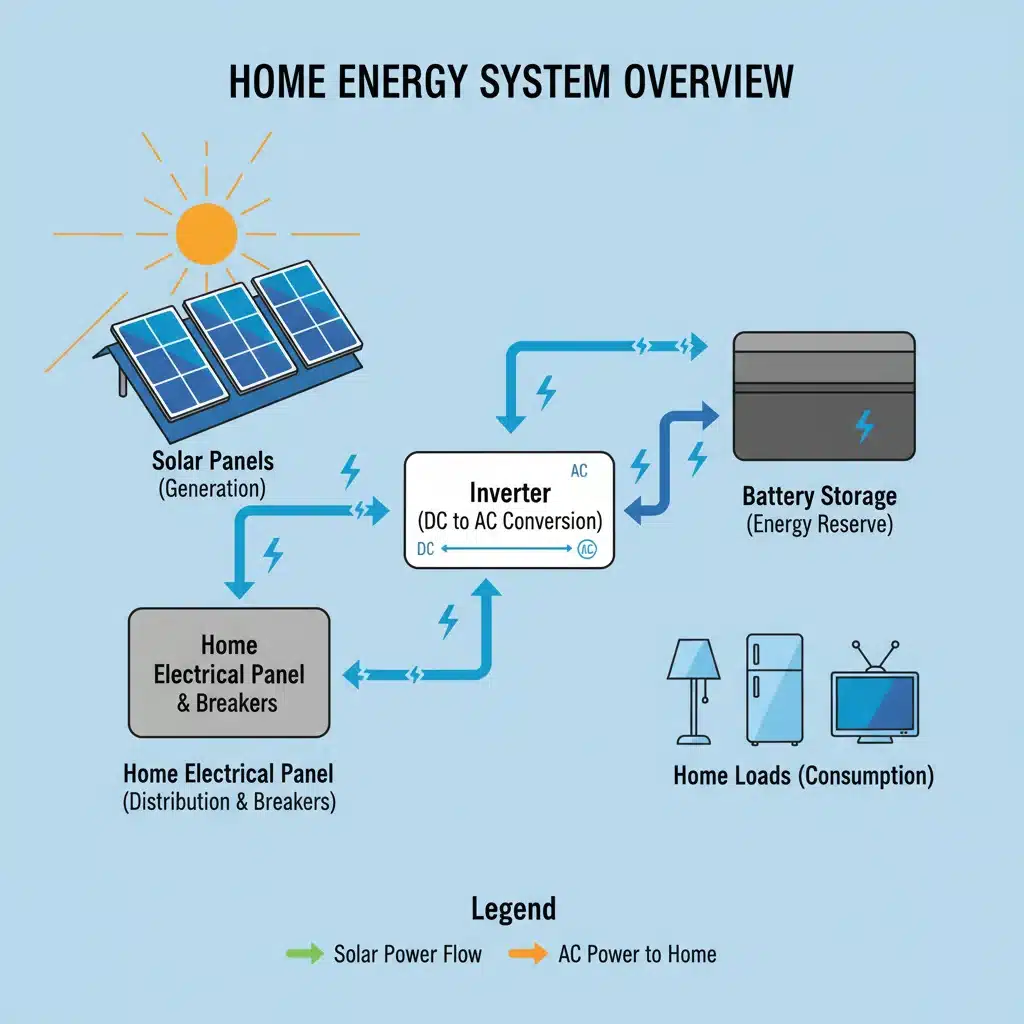
While the focus here is on residential battery sizing for energy capacity, it’s crucial to briefly mention inverter sizing. The inverter is the component that converts the battery’s DC power into the AC power your home uses. Its power rating (in kilowatts, kW) must be high enough to handle your home’s peak simultaneous demand (the sum of all essential appliances running at once, including surge loads).
If your peak simultaneous demand is 5 kW, you’ll need an inverter rated for at least 5 kW, and often more to provide a buffer and handle surge currents. An undersized inverter will trip or fail under high load, even if your battery has plenty of energy. This is a critical parallel consideration to battery capacity.
By following these steps, you can move from a general idea of needing 48 hours of backup to a precise figure for the battery capacity your home truly requires, ensuring reliability and longevity for your investment.
Exploring Battery Technologies for Home Backup in 2026
The landscape of battery technology is constantly evolving, and for residential battery sizing, understanding the options available in 2026 is paramount. Each technology comes with its own set of advantages, disadvantages, and ideal applications.
Lithium-Ion Batteries: The Dominant Player
Lithium-ion (Li-ion) batteries, particularly Lithium Iron Phosphate (LFP or LiFePO4), remain the gold standard for residential energy storage. They offer:
- High Energy Density: More energy in a smaller, lighter package.
- High DoD: Typically 80-90%, meaning you can use a larger portion of the stored energy without damaging the battery.
- Long Cycle Life: Thousands of charge/discharge cycles, leading to a lifespan of 10-15+ years.
- High Efficiency: Excellent round-trip efficiency (how much energy is put in vs. how much can be taken out).
- Low Maintenance: Generally maintenance-free.
- Safety: LFP chemistry is known for its thermal stability and safety compared to other Li-ion variants.
Considerations: Higher upfront cost compared to lead-acid, though declining rapidly. Performance can degrade in extreme cold, though many systems now include thermal management.
Flow Batteries: Emerging Contenders
Flow batteries, such as vanadium redox flow batteries, are gaining traction, especially for larger residential and commercial applications. Their key features include:
- Long Lifespan: Potentially 20+ years and tens of thousands of cycles, as the energy storage component (electrolyte) is separate from the power conversion component.
- 100% DoD: Can be fully discharged without damage, simplifying residential battery sizing calculations.
- Scalability: Capacity can be increased by simply adding more electrolyte.
- Safety: Non-flammable electrolytes.
Considerations: Lower energy density (larger footprint), currently higher upfront cost, and more complex systems. Still less common for typical residential use but worth watching.
Lead-Acid Batteries: The Traditional Choice (with caveats)
While less common for new, high-performance residential solar-plus-storage systems, lead-acid batteries (especially sealed absorbed glass mat – AGM or gel) are still used, particularly for budget-conscious backup-only systems.
- Lower Upfront Cost: Significantly cheaper per kWh initially.
- Proven Technology: Decades of use.
Considerations:
- Lower DoD: Typically 50%, meaning you need double the nominal capacity compared to Li-ion for the same usable energy.
- Shorter Cycle Life: Fewer charge/discharge cycles, leading to a shorter lifespan (3-7 years).
- Lower Efficiency: More energy lost during charging and discharging.
- Maintenance: Some types (flooded) require regular watering.
- Larger Footprint: Heavier and bulkier for the same usable energy.
- Temperature Sensitivity: Performance and lifespan are more affected by temperature extremes.
Sodium-Ion Batteries: The Future?
Sodium-ion batteries are an exciting, rapidly developing technology in 2026. They promise to offer a more sustainable and potentially cheaper alternative to lithium-ion, as sodium is abundant. While not yet widely available for residential applications, they are expected to enter the market more broadly in the coming years, potentially impacting future residential battery sizing strategies with competitive pricing and performance.
When selecting a battery technology, consider your budget, desired lifespan, available space, and specific backup needs. For a 48-hour backup, especially one integrated with solar, lithium-ion (LFP) remains the most practical and efficient choice for most homeowners in 2026.
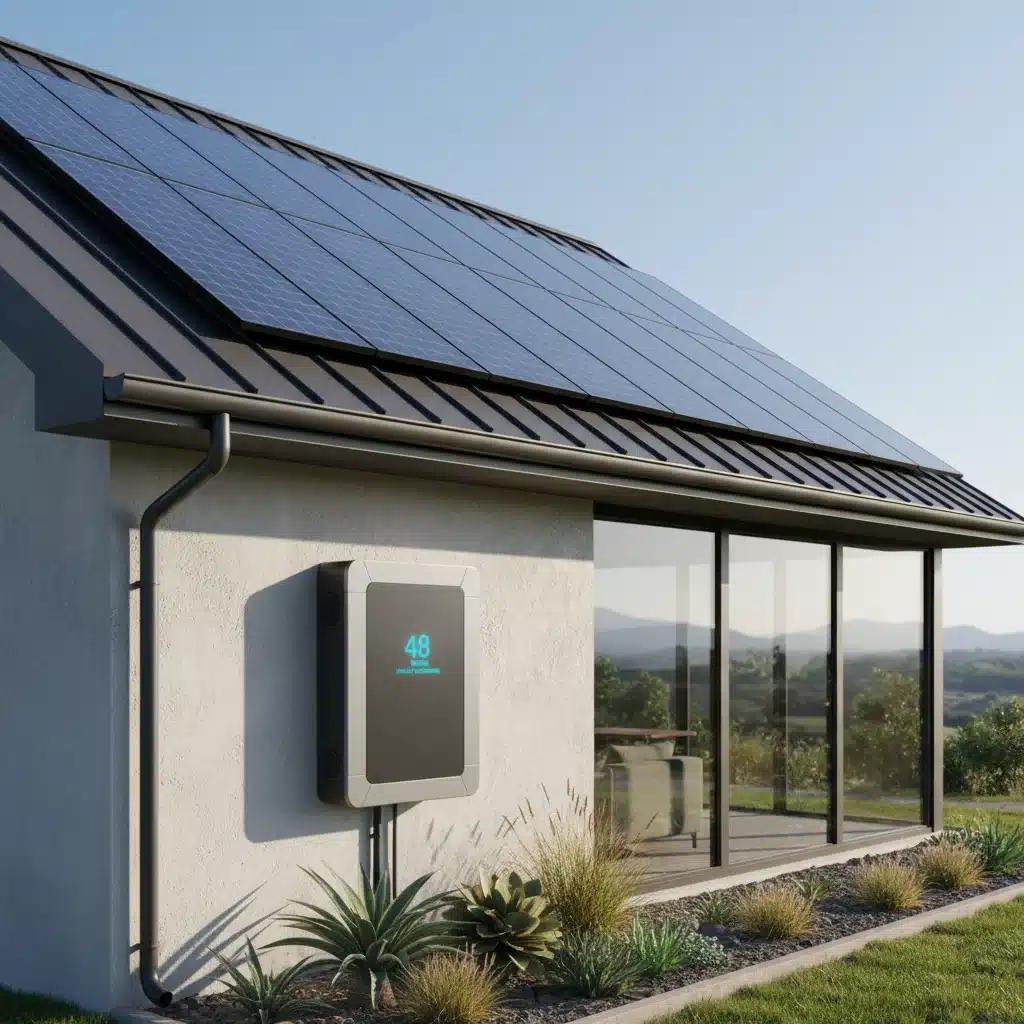
Integration with Solar and Grid: Optimizing Your System
While residential battery sizing for 48-hour backup can be done for a standalone system, integrating it with solar panels and understanding its interaction with the grid offers significant benefits and optimization opportunities. In 2026, standalone battery systems are becoming less common as homeowners seek to maximize their energy independence and financial returns through solar integration.
Solar-Plus-Storage Systems
The synergy between solar panels and battery storage is powerful. During daylight hours, your solar panels generate electricity. This power can directly supply your home’s needs, and any excess can be stored in your battery. When the sun isn’t shining (at night or during cloudy days), or during a grid outage, your home draws power from the battery. This creates a highly resilient and often more economical energy ecosystem.
Benefits of Solar Integration:
- Continuous Charging: Solar panels can recharge your battery during a prolonged outage, extending your backup duration far beyond the initial 48 hours. This is a critical advantage.
- Reduced Grid Dependence: Minimize reliance on utility power, potentially lowering electricity bills.
- Self-Consumption Optimization: Use your self-generated solar power even when the sun isn’t shining, avoiding peak time electricity rates.
- Environmental Impact: Maximize your use of clean, renewable energy.
Grid Interaction: On-Grid, Off-Grid, and Hybrid Systems
Your battery system’s interaction with the grid defines its operational mode:
- On-Grid (Grid-Tied with Backup): This is the most common setup. Your home remains connected to the utility grid. When the grid is active, your solar panels can feed excess power back to it (net metering). When the grid goes down, your battery takes over, automatically disconnecting from the grid to power your essential loads. This setup requires a specific type of inverter (hybrid or a separate battery inverter) that can island your home during an outage.
- Off-Grid: For homes completely disconnected from the utility grid. These systems rely solely on solar (or other renewable sources) and battery storage for all power needs. Residential battery sizing for off-grid homes is much more rigorous, often requiring significantly larger capacities to account for extended periods of low solar production. A 48-hour backup is a minimum, and often much more is needed.
- Hybrid Systems: These systems combine aspects of both on-grid and off-grid. They are connected to the grid but are designed to prioritize self-consumption of solar and battery power, only drawing from the grid when necessary. They offer flexibility in energy management, often leveraging time-of-use rates by charging batteries when electricity is cheap and discharging when it’s expensive.
Smart Energy Management Systems
Modern battery systems in 2026 come with sophisticated energy management software. These systems can:
- Monitor Energy Flow: Track solar production, battery charge, home consumption, and grid interaction in real-time.
- Optimize Charging/Discharging: Learn your usage patterns and local electricity rates to automatically charge the battery when power is cheapest (e.g., from solar or off-peak grid power) and discharge when power is most expensive or during an outage.
- Prioritize Loads: Some advanced systems allow you to designate critical loads that receive power first during an outage, ensuring your 48-hour backup covers your most essential needs.
- Remote Control and Monitoring: Manage your system from a smartphone or computer, receiving alerts and adjusting settings.
When planning your residential battery sizing for 48 hours, consider how these integration options can enhance your system’s performance, resilience, and overall value. A well-integrated solar-plus-storage system offers not just backup, but true energy independence and smart energy management.
Installation Considerations and Safety Protocols
Once you’ve meticulously completed your residential battery sizing and chosen your preferred battery technology, the next crucial phase is installation. This is not a DIY project for most homeowners, as it involves high-voltage electricity, complex wiring, and adherence to strict safety codes. Proper installation is paramount for the system’s efficiency, longevity, and, most importantly, safety.
Professional Installation is Key
Always engage certified and experienced professionals for battery system installation. They possess the necessary expertise to:
- Adhere to Electrical Codes: Ensure compliance with national and local electrical codes (e.g., NEC in the US) and utility interconnection requirements.
- Proper Wiring and Connections: Correctly wire the battery, inverter, solar (if applicable), and your home’s electrical panel.
- System Commissioning: Configure the battery management system (BMS) and inverter for optimal performance and safety.
- Troubleshooting: Address any issues that arise during installation or initial operation.
Hiring unqualified installers can lead to safety hazards, voided warranties, and system failures.
Location, Ventilation, and Environmental Factors
The physical placement of your battery system is critical for both performance and safety:
- Temperature Control: Batteries operate best within specific temperature ranges. Extreme heat can accelerate degradation, while extreme cold can reduce performance and capacity. A climate-controlled space like a garage, basement, or utility room is often ideal. Outdoor installations require purpose-built, weather-resistant enclosures with thermal management.
- Ventilation: While modern lithium-ion batteries are sealed and don’t off-gas like older lead-acid batteries, good ventilation is still important to dissipate any heat generated during operation.
- Accessibility: Ensure easy access for maintenance (though minimal for Li-ion) and potential future upgrades.
- Proximity to Inverter and Electrical Panel: Shorter cable runs reduce energy loss and installation costs.
- Structural Support: Batteries can be heavy. Ensure the mounting surface or floor can support the weight.
- Fire Safety: Install away from flammable materials and ensure appropriate fire suppression measures are considered, particularly in commercial settings or large residential arrays.
Safety Features and Protocols
Modern battery systems are designed with numerous safety features, but it’s essential to understand them:
- Battery Management System (BMS): This is the brain of the battery, monitoring voltage, current, temperature, and state of charge for individual cells. It prevents overcharging, over-discharging, and overheating, which are critical for Li-ion battery safety and longevity.
- Automatic Disconnects: Systems are designed to automatically disconnect from the grid during an outage to prevent backfeeding power to the utility lines, protecting utility workers.
- Circuit Breakers and Fuses: Standard electrical safety components protect against overcurrents.
- Emergency Shut-off: Easily accessible emergency shut-off switches should be part of the installation.
- Arc Fault and Ground Fault Protection: These features detect dangerous electrical conditions and shut down the system.
Permitting and Inspections
Almost all battery storage installations require permits from your local municipality and inspections by electrical authorities. Your installer should handle this process, ensuring all necessary paperwork is filed and inspections are passed. This verifies that the installation meets all safety and building codes.
Warranty and Maintenance
Understand the warranty for both the battery (typically 10+ years for Li-ion, often guaranteeing a certain capacity retention) and the inverter/other components. While Li-ion batteries are low maintenance, regular system checks by a professional every few years are recommended to ensure optimal performance and identify any potential issues early. This proactive approach helps safeguard your investment in residential battery sizing for reliable 48-hour backup.
Cost-Benefit Analysis and Return on Investment (ROI)
Investing in a home battery system for 48-hour backup is a significant financial decision. A thorough cost-benefit analysis and understanding the potential return on investment (ROI) are crucial parts of the residential battery sizing process, extending beyond just the technical specifications.
Upfront Costs
The primary barrier for many homeowners is the initial investment. Costs for a 10-20 kWh lithium-ion battery system (the range often needed for 48-hour backup, depending on your load and DoD) can vary widely, typically ranging from $10,000 to $25,000 or more, including the battery, inverter, installation, and associated electrical work. Factors influencing cost include:
- Battery Capacity: Larger capacities cost more.
- Battery Chemistry: Li-ion (especially LFP) is more expensive than lead-acid upfront, but offers better long-term value.
- Inverter Type: Hybrid inverters or separate battery inverters add to the cost.
- Installation Complexity: Factors like trenching, panel upgrades, or specific mounting requirements can increase labor costs.
- Brand and Features: Premium brands or systems with advanced smart features may cost more.
Financial Incentives and Rebates
This is where the ROI picture brightens considerably. In 2026, numerous incentives are available to offset the cost of residential battery sizing and installation:
- Federal Tax Credit (ITC): The Investment Tax Credit (ITC) for solar and storage systems remains a significant federal incentive, offering a percentage (currently 30%) of the eligible system cost as a tax credit. This is a direct reduction in your tax liability.
- State and Local Programs: Many states, counties, and even utility companies offer their own rebates, grants, or tax incentives for energy storage. These can sometimes be stacked with federal incentives.
- Virtual Power Plants (VPPs): Some utilities offer incentives for homeowners to allow their batteries to participate in VPPs. In a VPP, your battery can discharge power back to the grid during peak demand times, helping grid stability, and you receive compensation for this service.
- Net Metering (for Solar-plus-Storage): While not directly for the battery, net metering policies allow you to earn credits for excess solar energy sent to the grid, which can then be drawn upon later, indirectly reducing the need to discharge your battery for daily use.
Always research the specific incentives available in your region, as they can dramatically reduce the net cost of your system.
Long-Term Savings and Benefits
The ROI for residential battery sizing extends beyond just incentives:
- Energy Bill Savings: If paired with solar, you maximize self-consumption, reducing reliance on grid electricity, especially during expensive peak hours (time-of-use rates).
- Demand Charge Reduction: For homes with demand charges, batteries can shave off peak demand, leading to significant savings.
- Increased Home Value: Homes with integrated solar and battery storage often command a higher resale value.
- Peace of Mind and Resilience: This is an intangible but invaluable benefit. The ability to maintain power during outages, protect against food spoilage, and keep essential medical devices running provides significant peace of mind. For many, this alone justifies the investment.
- Environmental Impact: Contributing to a cleaner energy grid and reducing your carbon footprint is a benefit that aligns with sustainable living goals.

Calculating Your Payback Period
To estimate your ROI, you can calculate a rough payback period:
Payback Period (Years) = (Total System Cost - Total Incentives) / Annual Savings (Energy Bills + VPP Payments)
While the payback period for battery-only systems might be longer if not paired with solar or significant time-of-use arbitrage, the combination of resilience, environmental benefits, and declining battery costs, coupled with robust incentives in 2026, makes battery storage an increasingly sound investment for homeowners seeking 48-hour backup.
Advanced Considerations and Future Trends for 2026 and Beyond
As we delve deeper into 2026 and look towards the future, residential battery sizing and home energy management are becoming increasingly sophisticated. Beyond the core calculations, several advanced considerations and emerging trends will shape how homeowners approach energy independence.
Smart Home Integration and AI-Powered Management
The integration of battery systems with broader smart home ecosystems is a significant trend. AI and machine learning algorithms are being employed to optimize energy usage:
- Predictive Analytics: Systems analyze weather forecasts, electricity price fluctuations, and historical usage patterns to intelligently manage charging and discharging. For example, if a storm is predicted, the system might prioritize fully charging the battery for backup.
- Automated Load Shifting: Smart appliances can communicate with the battery system, automatically running high-draw tasks (like laundry or dishwashing) when solar production is high or electricity rates are low, further maximizing self-consumption and savings.
- Voice Control and Seamless Interfaces: Managing your home’s energy will become as intuitive as controlling your lights, with voice commands and user-friendly apps providing real-time data and control.
Vehicle-to-Home (V2H) and Vehicle-to-Grid (V2G) Technologies
Electric Vehicles (EVs) are essentially large batteries on wheels. V2H technology allows your EV to power your home during an outage, effectively acting as an additional, mobile battery backup. V2G takes this a step further, allowing your EV to feed power back to the grid during peak demand, earning you credits.
For residential battery sizing, V2H/V2G capabilities mean you might be able to size a smaller dedicated home battery if your EV can provide significant backup power. While still emerging, compatible EVs and charging infrastructure are becoming more prevalent in 2026.
Grid Services and Virtual Power Plants (VPPs)
As mentioned previously, VPPs are becoming a powerful tool for grid operators to manage demand and for homeowners to monetize their battery storage. By allowing your battery to discharge small amounts of power back to the grid during peak times, you help stabilize the grid and receive compensation. This not only improves the ROI of your battery system but also contributes to broader energy resilience.
Modular and Scalable Battery Systems
Many modern battery systems are designed to be modular, allowing homeowners to start with a smaller capacity and add more battery modules later as their needs change or budget allows. This flexibility is particularly beneficial for residential battery sizing, as it mitigates the risk of over- or under-sizing your initial investment and allows for future expansion if your energy consumption increases (e.g., adding an EV or more appliances).
Enhanced Safety Standards and Battery Recycling
With the proliferation of home batteries, safety standards are continually being refined and improved. Expect more rigorous testing, fire suppression technologies, and advanced BMS features. Furthermore, the industry is increasingly focusing on battery recycling programs to ensure responsible end-of-life management for these valuable resources, reducing environmental impact.
Long-Duration Storage Solutions
While this guide focuses on 48-hour backup, research and development are rapidly progressing on long-duration energy storage (LDES) solutions, which could provide days or even weeks of backup. Technologies like flow batteries, compressed air energy storage, and thermal storage are moving closer to commercial viability. While not yet mainstream for residential use, these will impact future possibilities for extreme energy independence.
Staying informed about these advancements is crucial for making the most out of your residential battery sizing decision. The future of home energy is dynamic, and by embracing these trends, homeowners can achieve unprecedented levels of energy independence, resilience, and financial benefit.
Conclusion: Empowering Your Home with 48 Hours of Energy Independence
Achieving 48 hours of home energy independence through a well-sized residential battery system is no longer a futuristic dream but a practical and increasingly accessible reality in 2026. This comprehensive guide has walked you through the intricate yet essential steps of residential battery sizing, from meticulously understanding your home’s unique energy profile to calculating precise capacity requirements, exploring cutting-edge battery technologies, and considering critical installation and financial aspects.
We’ve emphasized the foundational importance of identifying your essential loads, dissecting daily consumption, and then applying crucial factors like Depth of Discharge and system efficiency to arrive at an accurate nominal battery capacity. Recognizing that a one-size-fits-all approach is insufficient, we’ve provided the tools to tailor a solution that perfectly matches your household’s needs and resilience goals.
The integration of battery storage with solar PV systems stands out as the most powerful pathway to true energy independence, offering not just backup during outages but also significant long-term savings through optimized self-consumption and smart energy management. Furthermore, understanding the evolving landscape of financial incentives – from federal tax credits to local rebates and participation in Virtual Power Plants – is key to making your investment not only practical but also financially sound.
As technology continues to advance, with smart home integration, AI-powered energy management, and Vehicle-to-Home capabilities becoming more commonplace, the benefits and intelligence of residential battery systems will only grow. By choosing professional installation, adhering to safety protocols, and staying informed about future trends, you are not just purchasing a battery; you are investing in a future of unparalleled reliability, sustainability, and peace of mind for your home.
Embrace the power of knowing your home is prepared, resilient, and contributing to a more sustainable energy future. Your journey to 48 hours of energy independence begins with informed residential battery sizing, and with this guide, you are well-equipped to make that journey a success.