SMRs vs. Traditional Nuclear: Cost-Effectiveness for U.S. Energy Security
Anúncios
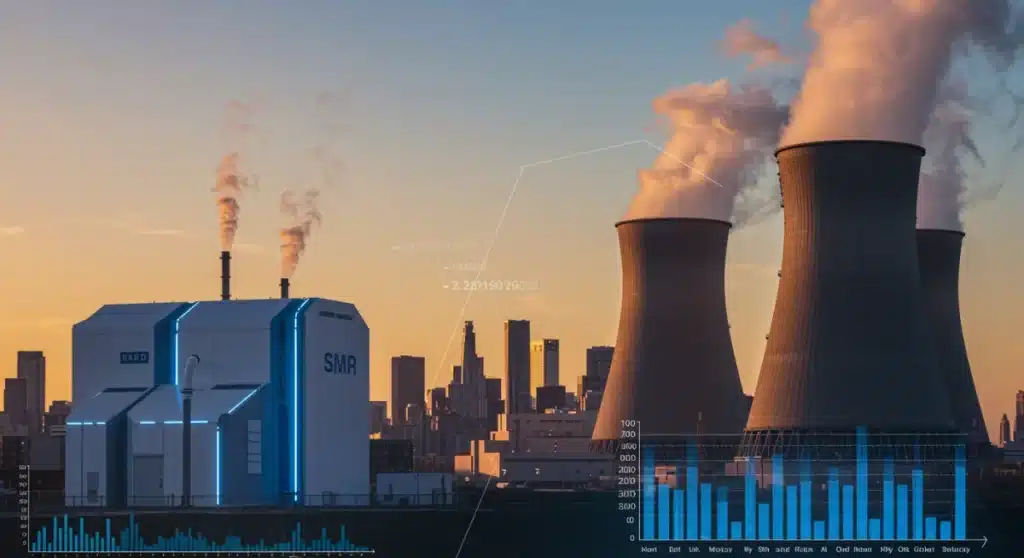
This analysis evaluates the cost-effectiveness of small modular reactors (SMRs) against traditional nuclear plants, assessing their potential roles in bolstering U.S. energy security over the coming five years, considering economic, operational, and strategic factors.
A thorough comparative analysis: evaluating the cost-effectiveness of small modular reactors (SMRs) vs. traditional nuclear plants for U.S. energy security in the next 5 years is crucial for shaping America’s energy future. As the nation seeks reliable, low-carbon power sources, understanding the economic and strategic implications of these two nuclear technologies becomes paramount.
The evolving landscape of nuclear energy in the U.S.
The United States faces a complex energy challenge: meeting growing electricity demand while transitioning to a cleaner grid. Nuclear power, long a cornerstone of baseload generation, is undergoing a significant transformation with the advent of SMRs. This section explores how these new technologies are poised to reshape the energy mix.
Traditional nuclear power plants have provided reliable, carbon-free electricity for decades. However, their large upfront capital costs, lengthy construction times, and complex regulatory processes have presented significant hurdles to new builds. The sheer scale of these projects often leads to financial overruns and delays, making them less attractive in a rapidly changing energy market.
Challenges facing traditional nuclear builds
- High capital expenditure: Billions of dollars are required for initial construction, often necessitating government loan guarantees.
- Extended construction schedules: Projects can take 10-15 years or more to complete, tying up capital for prolonged periods.
- Regulatory complexities: Navigating stringent licensing and safety protocols adds time and cost.
- Public perception: Concerns about safety, waste disposal, and potential accidents continue to influence public opinion.
In contrast, SMRs offer a potentially more flexible and economically viable path forward. Their smaller size and modular design promise factory fabrication, reduced construction times, and enhanced safety features. This shift could democratize nuclear power, making it accessible to a wider range of applications and locations.
The U.S. Department of Energy (DOE) has actively supported SMR development, recognizing their potential to contribute significantly to energy security and decarbonization goals. This support includes funding for research, development, and demonstration projects, aiming to accelerate their deployment.
The evolving landscape suggests a future where both traditional and advanced nuclear technologies might coexist, each fulfilling specific roles. Traditional plants could continue to provide large-scale baseload power, while SMRs could serve smaller grids, remote communities, or industrial applications requiring process heat. This duality offers a robust approach to energy diversification.
Understanding SMRs: advantages and economic potential
Small modular reactors (SMRs) represent a paradigm shift in nuclear technology, offering distinct advantages over their larger predecessors. Their inherent design characteristics contribute to a potentially more favorable economic profile, making them attractive for future energy investments. This section delves into these advantages and their economic implications.
One of the primary benefits of SMRs is their modularity. Being factory-built, they can achieve economies of series production, where manufacturing costs decrease with each unit produced. This contrasts sharply with traditional nuclear plants, which are custom-built on-site, limiting cost efficiencies from replication.
Key advantages of SMR technology
- Reduced capital costs: Smaller size means lower upfront investment, potentially attracting more private financing.
- Shorter construction times: Factory fabrication and assembly on-site can significantly cut project durations.
- Enhanced safety features: Many SMR designs incorporate passive safety systems, requiring less active intervention and reducing the risk of accidents.
- Flexible deployment: Can be sited in a wider range of locations, including those with limited water availability or grid capacity.
- Scalability: Power output can be adjusted by adding or removing modules, matching energy demand more precisely.
The economic potential of SMRs extends beyond just construction costs. Their smaller footprint means less land acquisition and preparation, further reducing initial expenditures. Moreover, their simpler designs can lead to lower operational and maintenance costs over their lifespan. The ability to integrate SMRs into existing infrastructure, such as retired coal plant sites, also offers economic benefits by utilizing existing transmission lines and skilled workforces.
Furthermore, the potential for SMRs to produce process heat for industrial applications, or to support hydrogen production and water desalination, opens new revenue streams. This versatility enhances their overall economic value proposition, making them more competitive in a diverse energy market. The U.S. government’s continued investment in SMR research and development signals a strong belief in their long-term economic viability and strategic importance for energy independence.
Cost structures: traditional nuclear vs. SMRs
A comprehensive understanding of the cost structures for both traditional nuclear plants and SMRs is essential for evaluating their long-term viability and impact on U.S. energy security. This comparison goes beyond initial construction to include operating, maintenance, and decommissioning costs, which collectively determine the levelized cost of electricity (LCOE).
Traditional nuclear power plants are characterized by immense capital costs, often ranging in the tens of billions of dollars. These costs are driven by their large size, custom engineering, extensive safety systems, and the need for robust containment structures. The financing of such projects typically involves substantial government support or large utility balance sheets, making them challenging to fund entirely through private capital.
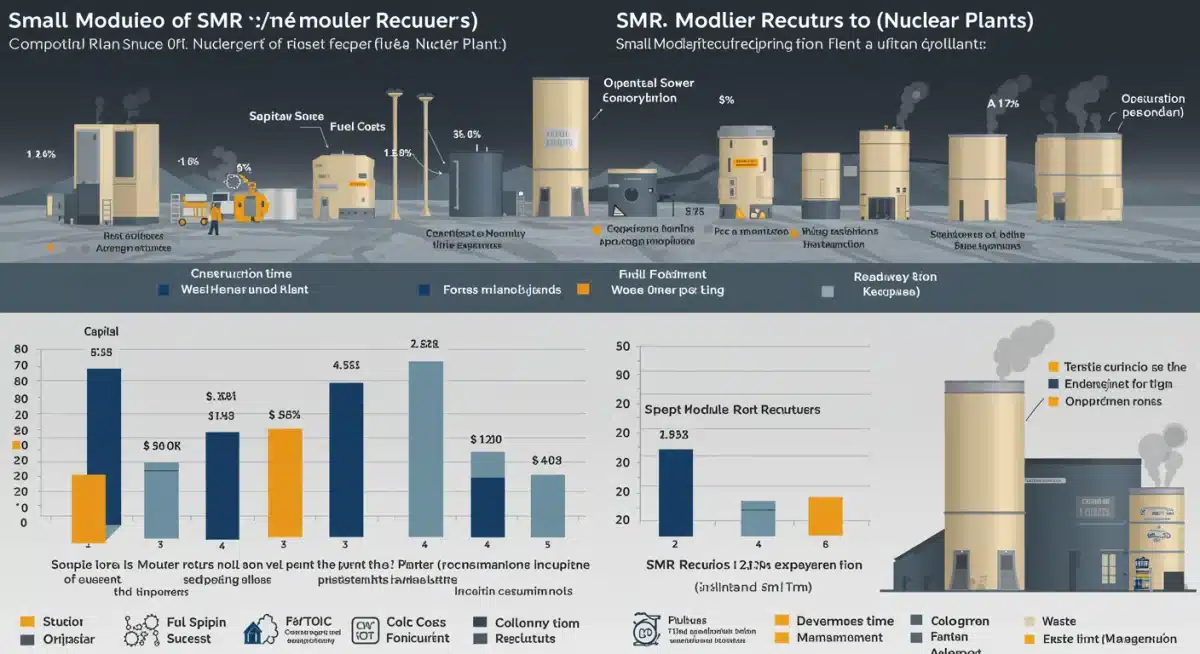
Cost components comparison
- Capital costs: Traditional plants have significantly higher upfront costs per unit of power. SMRs aim for lower per-unit costs through modular design; traditional plants have high, multi-billion dollar investments.
- Operating and maintenance (O&M): While traditional plants have economies of scale in O&M, SMRs might benefit from simpler designs and automation, potentially lowering O&M per MWh.
- Fuel costs: Both technologies use uranium, so fuel costs are relatively similar per unit of energy produced, although SMRs might have slightly different refueling cycles.
- Decommissioning costs: Decommissioning large traditional plants is a multi-billion dollar endeavor. SMRs, being smaller, are projected to have lower decommissioning costs, though the exact figures are still being refined.
The LCOE, which accounts for all costs over a plant’s lifetime divided by its total energy output, is a critical metric. For traditional nuclear, LCOE can be competitive once built, but the long construction periods and high upfront costs can inflate the effective cost. SMRs, with their promise of shorter construction and economies of series, aim to deliver a more competitive LCOE, particularly as deployment scales up.
Furthermore, the risk associated with financing and construction delays is often higher for traditional plants. SMRs, through their modularity and established manufacturing processes, could mitigate some of these financial risks, making them more attractive to investors. This shift in risk profile is a crucial element in their potential to secure private investment and accelerate deployment without relying solely on public funds.
Impact on U.S. energy security in the next 5 years
The strategic deployment of either SMRs or traditional nuclear plants holds significant implications for U.S. energy security over the next half-decade. Energy security encompasses not just the availability of power but also its reliability, resilience, and independence from volatile global markets. Both technologies offer unique contributions to these objectives.
Traditional nuclear plants, with their large, consistent output, have long been a pillar of baseload power, providing a stable foundation for the grid. Their fuel source, uranium, is globally distributed but can be stored for long periods, offering a hedge against supply disruptions. However, the long lead times for traditional plants mean that any new contributions to energy security from this sector within the next five years would largely come from existing facilities or those already under construction.
SMRs and enhanced grid resilience
- Distributed generation: SMRs can be deployed closer to demand centers, reducing transmission losses and improving grid stability.
- Black start capabilities: Some SMR designs offer the ability to restart independently after a grid blackout, enhancing resilience.
- Reduced physical footprint: Allows for siting in diverse locations, including remote areas or industrial parks, diversifying power sources.
- Protection against cyber threats: Decentralized SMRs could present a more complex target for cyber attacks compared to a few large, centralized plants.
Within the next five years, the primary impact of SMRs on U.S. energy security will likely be through accelerated licensing and initial deployments. While widespread commercial operation of SMRs might take longer, successful pilot projects and the establishment of regulatory frameworks will build confidence and pave the way for future scalability. This initial phase is crucial for demonstrating their operational reliability and economic viability.
Moreover, the ability of SMRs to replace retiring fossil fuel plants, particularly coal, offers a dual benefit: maintaining baseload power while reducing carbon emissions. This transition enhances energy security by diversifying the generation mix and reducing reliance on fossil fuels, which are subject to price volatility and geopolitical influences. The investment in domestic SMR manufacturing also supports national security by strengthening the U.S. industrial base and creating high-tech jobs.
Technological readiness and deployment timelines
The practical realization of nuclear power’s potential, whether through traditional plants or SMRs, is heavily dependent on technological readiness and realistic deployment timelines. While traditional nuclear technology is mature, SMRs are still in various stages of development and commercialization, which impacts their near-term contribution to U.S. energy security.
Traditional nuclear reactors, primarily light water reactors, have a proven track record spanning decades. The technology is well-understood, and the regulatory processes are established, albeit lengthy. New traditional builds, if undertaken, would rely on existing designs, potentially leveraging lessons learned from recent projects to streamline construction, though the fundamental challenges of scale and financing remain.
SMR development phases and challenges
- Design certification: Several SMR designs are currently undergoing or have completed certification by the Nuclear Regulatory Commission (NRC).
- First-of-a-kind (FOAK) costs: Initial SMR deployments will incur higher costs due to non-recurring engineering expenses and regulatory pioneering.
- Supply chain development: Establishing a robust manufacturing and supply chain for modular components is crucial for achieving cost reductions from series production.
- Workforce training: A specialized workforce will be needed for SMR manufacturing, construction, and operation, requiring significant investment in training programs.
Within the next five years, the U.S. is likely to see the first commercial deployment of a few SMR designs, such as NuScale Power’s reactor, which has already received NRC design approval. These initial projects will be critical test cases, demonstrating the practical aspects of SMR construction, operation, and integration into the grid. Their success will be vital for attracting further investment and accelerating broader adoption.
Conversely, significant new traditional nuclear plant construction within the next five years is unlikely to reach operational status. The focus for traditional nuclear will remain on optimizing the performance and extending the lifespans of existing reactors. Therefore, SMRs, despite being newer, hold the potential for more immediate new capacity additions, albeit on a smaller scale initially, due to their faster potential deployment cycles.
Regulatory frameworks and public acceptance
The success and widespread adoption of both traditional nuclear power and SMRs are intrinsically linked to robust regulatory frameworks and broad public acceptance. These factors profoundly influence project timelines, costs, and the overall feasibility of nuclear energy expansion in the United States. Understanding these dynamics is crucial for projecting their impact over the next five years.
For traditional nuclear plants, the Nuclear Regulatory Commission (NRC) has a well-established, albeit complex and time-consuming, licensing process. This rigor ensures safety but contributes to the long lead times and high costs associated with new builds. Any significant changes to this framework would require legislative action and substantial public and industry consensus, which is a slow process.
Addressing regulatory and public concerns for SMRs
- Streamlined licensing: The NRC is adapting its licensing process for SMRs, aiming for more efficient reviews given their standardized designs and passive safety features.
- Enhanced safety demonstrations: SMR developers are focusing on designs that are intrinsically safer, which can help alleviate public concerns.
- Community engagement: Proactive communication with local communities about the benefits and safety of SMRs is vital for gaining acceptance.
- Waste management solutions: Continued progress on long-term nuclear waste disposal solutions is critical for both traditional and SMR technologies to maintain public trust.
SMRs face the dual challenge of navigating existing nuclear regulations while also establishing new precedents for their unique designs and operational characteristics. The NRC has been actively working with SMR developers to create a more efficient review process, recognizing the differences in scale and safety profiles. This adaptation is key to realizing the faster deployment potential of SMRs.
Public acceptance is another critical hurdle. While nuclear power generally has moderate support, specific projects can face strong local opposition. For SMRs, their smaller size, passive safety systems, and potential for factory fabrication may help improve public perception by reducing perceived risks and demonstrating economic benefits to local communities. Effective communication and transparent engagement are paramount.
Over the next five years, the regulatory landscape for SMRs is expected to solidify further, with initial licenses issued and operational experience gained. This period will be crucial for building a track record of safety and reliability, which will, in turn, influence public opinion and pave the way for broader deployment. Without strong regulatory oversight and public trust, neither SMRs nor traditional nuclear plants can fully contribute to U.S. energy security goals.
Strategic implications for U.S. energy independence
The strategic implications of SMRs and traditional nuclear plants for U.S. energy independence are profound, extending beyond mere electricity generation to encompass national security, economic stability, and geopolitical influence. A diversified and resilient energy portfolio is a cornerstone of national independence, and nuclear power plays a critical role in achieving this.
Traditional nuclear plants contribute significantly to energy independence by providing a stable, domestic source of baseload power that is not subject to the price volatility of fossil fuels or the intermittency of renewables. Their long operational lifespans mean they offer decades of predictable power generation, reducing reliance on imported energy sources and insulating the U.S. economy from global energy shocks.
SMRs and enhanced energy independence
- Reduced reliance on fossil imports: SMRs can displace natural gas and coal, lessening dependence on volatile global markets.
- Decentralized power generation: Multiple, smaller SMRs can provide regional energy independence, reducing the impact of large-scale grid failures.
- Export potential: U.S. leadership in SMR technology can create export opportunities, strengthening economic ties and influencing global energy markets.
- Domestic manufacturing growth: Factory production of SMRs stimulates domestic industry, creates jobs, and reinforces the U.S. technological base.
Within the next five years, the strategic value of SMRs will begin to crystalize through initial deployments. These projects will demonstrate the feasibility of a decentralized nuclear energy model, which can enhance grid resilience and provide power to critical infrastructure or remote military bases. This modularity offers a strategic advantage, as it makes the energy system less vulnerable to single points of failure.
Moreover, developing a strong domestic SMR industry has significant geopolitical implications. It positions the U.S. as a leader in advanced nuclear technology, enabling it to set global standards for safety and security. This leadership is crucial in an era where other nations are also pursuing nuclear power, ensuring that U.S. values and non-proliferation principles are upheld. The ability to offer advanced, safe, and cost-effective nuclear solutions to allies further strengthens international partnerships and influence.
Ultimately, both SMRs and traditional nuclear plants are vital components of a robust strategy for U.S. energy independence. While traditional plants provide established baseload power, SMRs offer the flexibility, scalability, and enhanced security features needed to adapt to future energy challenges and maintain the nation’s competitive edge on the global stage. The next five years will be instrumental in laying the groundwork for this evolving nuclear future.
| Key Aspect | Comparative Insight |
|---|---|
| Capital Costs | SMRs aim for lower upfront costs through modular design; traditional plants have high, multi-billion dollar investments. |
| Deployment Time | SMRs project shorter construction times due to factory fabrication; traditional plants typically take 10+ years. |
| Energy Security | SMRs offer distributed generation and resilience; traditional plants provide large-scale baseload stability. |
| Regulatory Path | SMRs adapting existing NRC frameworks for efficiency; traditional plants rely on established, rigorous processes. |
Frequently asked questions about nuclear energy and SMRs
The main cost drivers for traditional nuclear plants include massive upfront capital investments for construction, extensive custom engineering, lengthy regulatory approval processes, and high-security requirements. These factors often lead to multi-billion dollar projects with long development timelines.
SMRs aim to reduce costs through modular, factory-built components, allowing for economies of series production. Their smaller size means lower capital expenditure, shorter construction times, and potentially simpler operational and maintenance requirements, contributing to a more competitive levelized cost of electricity.
Within the next five years, the U.S. is anticipated to see the first commercial deployments of certified SMR designs. While widespread adoption will take longer, initial projects will demonstrate operational viability and pave the way for scalability, gradually contributing to energy security goals.
SMRs enhance energy security through distributed generation, reducing reliance on centralized grids and vulnerable import chains. Their flexibility allows for deployment in diverse locations, including critical infrastructure, improving grid resilience and providing a stable, carbon-free power source independent of fossil fuel markets.
Public acceptance is crucial for nuclear energy expansion, influencing regulatory decisions and project viability. Addressing concerns about safety, waste management, and environmental impact through transparent communication and demonstrated operational reliability is essential for gaining community support for both traditional plants and SMRs.
Conclusion
The comparative analysis highlights that while traditional nuclear plants offer established, large-scale baseload power, their high capital costs and long construction times present significant hurdles. Small modular reactors, conversely, promise a more agile, cost-effective, and resilient path forward for U.S. energy security within the next five years. Their modularity, enhanced safety features, and potential for faster deployment position them as a crucial component of a diversified, decarbonized energy future. The initial successful deployments and regulatory advancements for SMRs will be instrumental in demonstrating their full potential, ultimately shaping a more secure and sustainable energy landscape for the nation.