Q1 2025 Update: Federal Incentives Boosting Geothermal Energy Adoption

Anúncios
New federal incentives introduced in Q1 2025 are significantly accelerating geothermal energy adoption across the United States, fostering a robust shift towards sustainable and renewable power sources nationwide.
The first quarter of 2025 brought forth significant policy shifts, with a particular focus on bolstering clean energy initiatives. Understanding the profound impact of new federal incentives on geothermal energy adoption across the US is crucial for stakeholders, investors, and environmentally conscious citizens alike. These measures are designed to catalyze a more sustainable energy future.
The Dawn of Enhanced Federal Support for Geothermal
The beginning of 2025 marked a pivotal moment for renewable energy in the United States, particularly for geothermal power. New federal incentives have been rolled out, designed to make this often-overlooked clean energy source more competitive and appealing to a broader range of developers and consumers. These policy changes are not merely incremental; they represent a strategic push to diversify the national energy portfolio and reduce reliance on fossil fuels.
Geothermal energy, derived from the Earth’s internal heat, offers a constant, reliable power source, unlike intermittent renewables such as solar and wind. However, its initial capital costs and specific geological requirements have historically posed barriers to widespread adoption. The Q1 2025 federal incentives aim to directly address these challenges, paving the way for a geothermal renaissance.
Key Legislative Changes and Their Immediate Implications
Several legislative adjustments underpin this new era of geothermal support. These changes are multifaceted, targeting various stages of geothermal project development, from exploration to grid integration.
- Expanded Tax Credits: The existing Investment Tax Credit (ITC) for geothermal projects has been significantly enhanced, offering a higher percentage of project costs as a credit.
- Direct Grants and Loan Programs: New federal programs now offer direct grants for innovative geothermal technologies and low-interest loans for project financing, reducing financial risk for developers.
- Streamlined Permitting Processes: Efforts are underway to simplify and expedite the federal permitting process for geothermal exploration and development, cutting down on lead times.
- Research and Development Funding: Increased allocations for R&D aim to advance drilling techniques, improve reservoir management, and develop next-generation geothermal systems.
The immediate implication of these changes is a more favorable economic environment for geothermal projects. Developers can now access capital more easily, and the reduced financial burden makes previously marginal projects economically viable. This shift is expected to attract new players to the geothermal sector and accelerate the expansion of existing operations.
In essence, the enhanced federal support signals a clear commitment from the government to position geothermal energy as a cornerstone of the nation’s clean energy transition. This proactive approach is critical for achieving ambitious climate goals and ensuring energy security for future generations.
Financial Mechanisms Driving Geothermal Growth
The core of the Q1 2025 federal incentives lies in their sophisticated financial mechanisms, carefully designed to stimulate investment and reduce the economic hurdles associated with geothermal energy projects. These mechanisms go beyond simple tax breaks, creating a comprehensive financial ecosystem that supports the entire lifecycle of geothermal development.
One of the most impactful changes is the introduction of a production tax credit (PTC) specifically tailored for geothermal electricity generation. This credit, paid out over a period for every kilowatt-hour of electricity produced, provides a stable revenue stream for operators, significantly improving project economics and attracting long-term investors. This complements the enhanced Investment Tax Credit, offering developers flexibility in choosing the most beneficial incentive structure for their particular project.
Understanding the New Tax Credit Structures
The revised tax credit framework is a game-changer. The ITC, for instance, now offers a higher base credit percentage, with additional bonus credits available for projects that meet specific criteria, such as using domestic content or being located in energy communities. This layered approach encourages not only geothermal deployment but also supports local economies and manufacturing.
- Investment Tax Credit (ITC): Increased base rate for geothermal system installation, applicable to both electricity generation and direct-use applications.
- Production Tax Credit (PTC): Long-term credits for electricity generated, providing predictable income and enhancing project bankability.
- Direct Pay Option: For certain entities, the option to receive tax credits as a direct payment, regardless of tax liability, democratizes access to incentives.
Beyond tax credits, new federal loan guarantee programs are de-risking early-stage geothermal exploration and development. These guarantees reduce the cost of borrowing for developers, making it easier to secure private financing for capital-intensive drilling operations. The combination of these financial tools creates a powerful incentive for both established energy companies and innovative startups to explore and develop geothermal resources across the US.
Technological Advancements and Resource Expansion
While financial incentives are crucial, their effectiveness is greatly amplified by ongoing technological advancements in geothermal energy. The Q1 2025 federal incentives also include provisions that directly support research and development in these areas, aiming to expand the geographical reach and economic viability of geothermal power.
Historically, geothermal development has been limited to regions with easily accessible high-temperature resources, such as those found along the Pacific ‘Ring of Fire’ or in specific volcanic areas. However, innovations in drilling techniques, enhanced geothermal systems (EGS), and co-produced geothermal applications are rapidly changing this landscape. The new federal funding is accelerating the deployment of these cutting-edge technologies.
One significant area of focus is Enhanced Geothermal Systems (EGS), which involve creating or enhancing fracture networks in hot, dry rock formations to extract heat. This technology has the potential to unlock vast geothermal resources in areas previously deemed unsuitable, dramatically expanding the footprint of geothermal power.
Innovations Opening Up New Geothermal Frontiers
The federal support specifically targets technologies that can lower drilling costs and increase efficiency. This includes advancements in:
- Advanced Drilling Technologies: Innovations like plasma drilling and closed-loop systems reduce the environmental impact and cost of accessing deep geothermal reservoirs.
- Enhanced Geothermal Systems (EGS): Funding for pilot projects and commercial deployment of EGS, making geothermal viable in more diverse geological settings.
- Co-produced Geothermal: Utilizing heat from existing oil and gas wells, transforming legacy infrastructure into new clean energy assets.
These technological breakthroughs, coupled with federal financial backing, are not only making geothermal more accessible but also more competitive. As these technologies mature and scale, the cost per kilowatt-hour of geothermal electricity is expected to decrease, further solidifying its position as a key player in the clean energy transition. The emphasis on R&D ensures that the US remains at the forefront of geothermal innovation.
Regional Impact and Adoption Trends Across the US
The impact of the Q1 2025 federal incentives on geothermal energy adoption is not uniform across the United States. While the general trend is positive, specific regions are poised for more significant growth due to their existing geological conditions, infrastructure, and state-level policy support. Understanding these regional nuances is key to appreciating the full scope of the federal initiative.
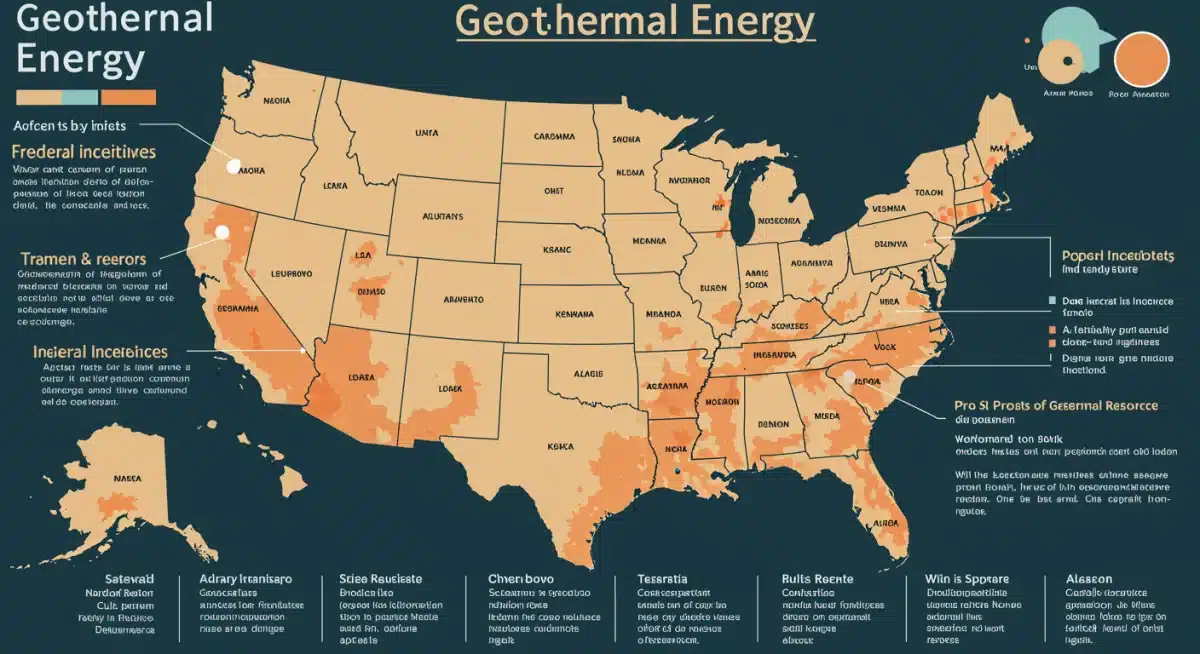
States in the Western US, particularly California, Nevada, and Utah, with their abundant high-temperature geothermal resources, are expected to see a rapid acceleration in project development. These regions have a long history of geothermal utilization and possess the existing expertise and supply chains to capitalize quickly on the new incentives. The financial support will likely enable the expansion of existing facilities and the development of new, previously uneconomical sites.
Geographical Hotbeds and Emerging Markets
Beyond the traditional Western geothermal hubs, the new incentives are also stimulating interest in emerging geothermal markets. States in the Gulf Coast, for example, are exploring co-produced geothermal from existing oil and gas infrastructure, leveraging their extensive well networks. The Northeast and Southeast, while lacking high-temperature resources, are seeing increased interest in direct-use geothermal applications and geothermal heat pumps for heating and cooling, supported by broader clean energy mandates.
- Western US: Expected to lead in large-scale geothermal power generation, with significant investment in EGS and conventional hydrothermal projects.
- Gulf Coast: Focus on co-produced geothermal from oil and gas wells, leveraging existing infrastructure for new clean energy streams.
- Midwest and East Coast: Growth in direct-use geothermal for district heating and cooling, and residential/commercial geothermal heat pump installations.
The federal government’s strategic focus on diverse geothermal applications ensures that the benefits of these incentives are felt nationwide, adapting to each region’s unique geological and economic characteristics. This tailored approach maximizes the potential for geothermal energy adoption across the entire country, fostering a truly national clean energy transition.
Challenges and Opportunities in Geothermal Expansion
While the Q1 2025 federal incentives present a monumental opportunity for geothermal energy, the path to widespread adoption is not without its challenges. Addressing these hurdles effectively will be crucial for maximizing the impact of the new policies and ensuring sustainable growth in the sector.
One primary challenge remains the upfront capital cost and perceived risk associated with geothermal exploration and drilling. Despite enhanced financial incentives, the initial investment required for drilling deep wells can be substantial, and the success of resource identification is not always guaranteed. Mitigating these risks through further de-risking mechanisms, such as federal insurance programs for exploration, could further accelerate development.
Navigating Regulatory Frameworks and Public Perception
Another significant hurdle is navigating complex regulatory and permitting processes, even with federal efforts to streamline them. State and local regulations can still pose delays, and securing land use permits, especially on federal lands, can be time-consuming. Furthermore, public perception and community engagement are vital; misconceptions about geothermal energy, such as induced seismicity or water usage, need to be addressed through transparent communication and education.
- High Upfront Costs: Despite incentives, initial capital for exploration and drilling remains a significant barrier.
- Regulatory Complexity: Navigating federal, state, and local permitting can cause delays and increase project costs.
- Public Acceptance: Addressing community concerns and educating the public on geothermal benefits is essential for social license.
- Skilled Workforce Development: A growing geothermal sector will require a specialized workforce, necessitating new training programs and educational initiatives.
However, these challenges also present opportunities. The need for a skilled workforce, for example, can stimulate job creation and educational programs in STEM fields. Overcoming regulatory hurdles can lead to more efficient governance models for renewable energy. By proactively addressing these challenges, the geothermal sector can solidify its position as a reliable and sustainable energy source for the US, driven by the renewed federal commitment.
Looking Ahead: The Long-Term Vision for Geothermal
The Q1 2025 federal incentives are not just about immediate project development; they represent a long-term vision for geothermal energy’s role in the US energy landscape. This vision extends beyond mere electricity generation, encompassing a broader integration of geothermal heat and power into various sectors of the economy.
The goal is to establish geothermal as a foundational component of a resilient, decarbonized energy system. Its baseload capacity provides stability and reliability, complementing intermittent renewable sources. The long-term strategy includes continued investment in R&D to unlock even greater geothermal potential, such as super-hot rock geothermal and advanced hybrid systems that combine geothermal with other renewables.
Geothermal’s Role in a Decarbonized Future
In the coming years, we can expect to see geothermal energy playing an increasingly critical role in achieving national decarbonization targets. This includes not only providing carbon-free electricity but also offering sustainable heating and cooling solutions for buildings, industrial processes, and even agricultural applications. The federal incentives are designed to foster this diversification and integration.
- Grid Stability: Geothermal’s continuous power output offers essential baseload stability to a grid increasingly reliant on intermittent renewables.
- Industrial Decarbonization: Direct-use geothermal heat can replace fossil fuels in various industrial processes, reducing emissions.
- Community Energy Resilience: Localized geothermal systems can enhance energy independence and resilience for communities.
- Job Creation: The expanding geothermal sector is projected to create thousands of skilled jobs in engineering, geology, drilling, and manufacturing.
The sustained federal commitment, coupled with ongoing technological innovation and increasing market demand for clean energy, paints a promising picture for geothermal’s future. The Q1 2025 incentives are a significant step towards realizing this vision, positioning the US as a global leader in geothermal energy development and deployment, and ensuring a cleaner, more secure energy future for all Americans.
| Key Point | Brief Description |
|---|---|
| Enhanced Federal Incentives | Q1 2025 saw significant boosts in federal tax credits (ITC, PTC) and loan programs for geothermal projects. |
| Technological Advancements | New funding supports EGS, advanced drilling, and co-produced geothermal, expanding resource accessibility. |
| Regional Adoption Trends | Western US leads in power generation, while other regions focus on direct-use and co-produced geothermal. |
| Challenges & Opportunities | Addressing high costs, regulatory hurdles, and public perception while creating jobs and grid stability. |
Frequently Asked Questions About Geothermal Incentives
The main incentives include significantly enhanced Investment Tax Credits (ITC) and new Production Tax Credits (PTC) for geothermal projects. Additionally, there are expanded federal loan guarantee programs, direct grants for innovative technologies, and efforts to streamline the permitting process to reduce development timelines and costs.
The incentives substantially reduce the net cost of geothermal projects. Tax credits offset a significant portion of capital expenditures or provide revenue for electricity produced, while loan guarantees lower borrowing costs. This financial support makes geothermal more competitive with traditional energy sources and other renewables.
The Western US, particularly states like California, Nevada, and Utah, with their high-temperature geothermal resources, are expected to see the most significant growth in power generation. However, new technologies and incentives also promote direct-use applications and co-produced geothermal in other regions, including the Gulf Coast and Eastern states.
While many incentives target utility-scale power generation, specific provisions also support residential and commercial geothermal heat pump installations. The ITC, for example, often applies to homeowners installing geothermal systems for heating and cooling, promoting broader adoption across different scales.
The long-term goals are to establish geothermal as a reliable, baseload component of the US clean energy mix, contribute significantly to decarbonization, and enhance energy security. The initiatives aim to stimulate technological innovation, create jobs, and foster a diverse and resilient national energy infrastructure for future generations.
Conclusion
The Q1 2025 update on new federal incentives for geothermal energy adoption marks a transformative period for clean energy in the United States. These comprehensive policies, ranging from enhanced tax credits and loan programs to support for technological innovation and streamlined permitting, are strategically designed to overcome historical barriers and unlock the vast potential of geothermal resources. While challenges such as initial capital costs and regulatory complexities persist, the robust federal commitment provides a strong foundation for sustainable growth. As these initiatives mature, geothermal energy is poised to play an increasingly vital role in decarbonizing the nation’s energy supply, ensuring grid stability, and fostering a resilient, clean energy future for all Americans.