US Carbon Capture Research 2026: Industrial Emissions Breakthroughs
Anúncios
The imperative to combat climate change has never been more urgent. As global temperatures continue to rise, driven largely by anthropogenic greenhouse gas emissions, the focus intensifies on innovative solutions to mitigate our environmental footprint. Among these, carbon capture, utilization, and storage (CCUS) technologies stand out as a critical pillar in the strategy to decarbonize heavy industries and achieve net-zero emissions. The United States, a global leader in scientific research and technological development, is at the forefront of this endeavor, with significant investments and groundbreaking discoveries emerging from its research institutions and industrial sectors. This article delves into the latest 2026 US research in US carbon capture technologies, exploring what these advancements mean for industrial emissions reduction and the future of our planet.
The year 2026 marks a pivotal moment in the evolution of carbon capture. Years of dedicated research and substantial funding have begun to yield tangible results, transforming theoretical concepts into practical, scalable applications. The US Department of Energy (DOE), alongside private industry and academic consortiums, has been instrumental in fostering an environment ripe for innovation. Their strategic roadmap for CCUS emphasizes not only the efficiency of capture but also the economic viability and long-term safety of storage and utilization. Understanding the nuances of these developments is crucial for anyone interested in environmental sustainability, industrial policy, and technological progress.
The Current Landscape of US Carbon Capture Technology
Before diving into the specifics of 2026 breakthroughs, it’s essential to contextualize the existing state of US carbon capture technology. Historically, carbon capture has faced challenges related to high costs, energy intensity, and scalability. Early technologies, primarily focused on post-combustion capture from power plants, often consumed a significant portion of the energy output, making them less attractive economically. However, continuous research and development have steadily chipped away at these barriers.
The US has seen a steady increase in operational and planned CCUS projects. These projects span various industries, including power generation (coal and natural gas), cement production, steel manufacturing, and chemical processing. The geographical advantage of the US, with its vast geological formations suitable for CO2 storage, further enhances its potential as a leader in this field. Policy incentives, such as the 45Q tax credit, have also played a crucial role in stimulating investment and accelerating deployment.
As of early 2026, the focus has broadened beyond just large-scale industrial emitters. There’s a growing interest in direct air capture (DAC) technologies, which extract CO2 directly from the atmosphere, offering a path to remove legacy emissions and achieve negative emissions targets. While DAC is still in its nascent stages compared to point-source capture, the pace of innovation is accelerating rapidly, driven by both technological advancements and increasing climate urgency.
Breakthroughs in Capture Efficiency and Cost Reduction
The core of US carbon capture research in 2026 revolves around two critical objectives: enhancing capture efficiency and significantly reducing operational costs. These two factors are intrinsically linked; a more efficient process often translates to lower energy consumption and thus reduced costs. Several key areas are showing remarkable progress:
Advanced Sorbent Materials
Traditional amine-based solvents, while effective, are energy-intensive to regenerate. 2026 research has seen significant advancements in novel sorbent materials. These include:
- Metal-Organic Frameworks (MOFs): Researchers have developed MOFs with highly tailored pore structures and chemical functionalities that can selectively adsorb CO2 with much lower energy penalties for regeneration. New synthetic routes have also made MOF production more scalable and cost-effective.
- Covalent Organic Frameworks (COFs): Similar to MOFs, COFs offer high porosity and tuneable properties. Recent breakthroughs have focused on increasing their stability in harsh industrial environments and improving their CO2 uptake capacity at low concentrations.
- Polymer-based Sorbents: New polymeric materials, often functionalized with specific chemical groups, are demonstrating excellent CO2 selectivity and regeneration characteristics. These are particularly promising for their potential ease of manufacturing and integration into existing industrial processes.
- Ionic Liquids and Deep Eutectic Solvents: These non-aqueous solvents offer lower volatility and energy requirements compared to traditional amines. 2026 research has focused on optimizing their composition for various industrial flue gas compositions and improving their long-term stability.
These next-generation sorbents are not just theoretical concepts; pilot projects across the US are demonstrating their efficacy, showing capture rates exceeding 90% with significantly reduced parasitic energy loads. This directly addresses one of the primary historical drawbacks of CCUS.
Membrane Technology Innovations
Membrane-based separation has long been considered a promising alternative to absorption processes due to its modularity and potentially lower energy footprint. 2026 has witnessed substantial progress in:
- Mixed-Matrix Membranes (MMMs): By incorporating highly selective inorganic fillers (like MOFs or zeolites) into a polymer matrix, researchers are creating MMMs that offer superior CO2 permeability and selectivity. The challenge of achieving strong adhesion between organic and inorganic phases has largely been overcome.
- Facilitated Transport Membranes: These membranes contain mobile carriers that selectively bind and transport CO2 across the membrane. Recent advancements have focused on developing more stable and efficient carrier molecules, leading to higher fluxes and better separation performance.
- High-Temperature Membranes: For certain industrial applications, capturing CO2 at higher temperatures can reduce the need for cooling, thus saving energy. New ceramic and metallic membranes capable of operating efficiently at elevated temperatures are emerging from US labs.
The scalability and compact nature of membrane systems make them particularly attractive for retrofitting existing industrial facilities and for modular deployment.
Process Intensification and Integration
Beyond novel materials, US carbon capture research is also focused on optimizing the entire capture process. This includes:
- Hybrid Systems: Combining different capture technologies, such as membranes with absorption, to leverage the strengths of each and mitigate their weaknesses.
- Advanced Process Control: Utilizing artificial intelligence and machine learning to optimize operating conditions, predict maintenance needs, and maximize capture efficiency in real-time.
- Waste Heat Recovery: Integrating CCUS units with industrial processes to utilize waste heat for sorbent regeneration, significantly reducing the overall energy penalty.
These integrated approaches are crucial for making CCUS a truly economically viable solution for a wide range of industrial applications.

Advancements in CO2 Utilization and Storage
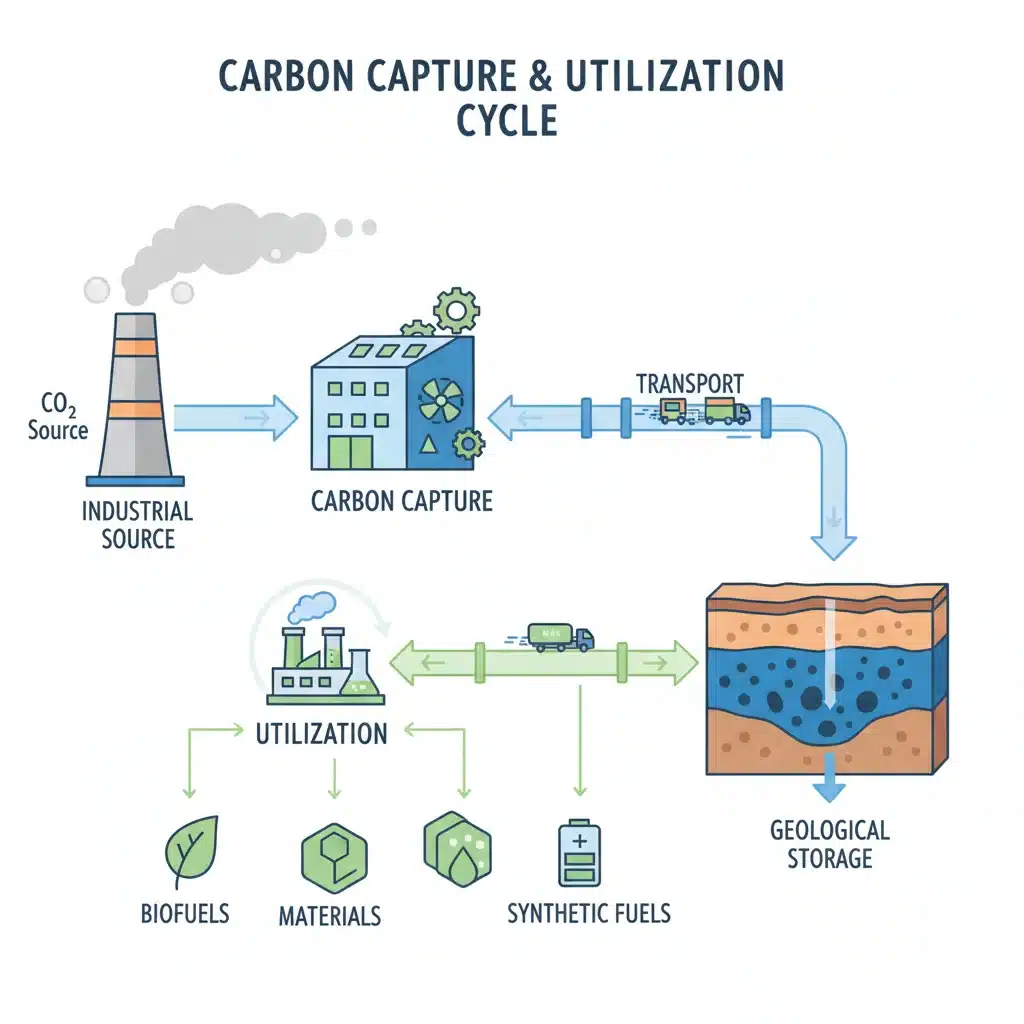
Capturing CO2 is only half the battle; what happens to it afterward is equally important. The 2026 US research landscape is robust in both carbon utilization (CCU) and carbon storage (CCS).
Carbon Utilization (CCU) Breakthroughs
Transforming captured CO2 into valuable products not only offsets capture costs but also creates new economic opportunities. Key areas of advancement include:
- Enhanced Oil Recovery (EOR) with a Green Twist: While EOR has been a long-standing application for CO2, 2026 research focuses on optimizing injection strategies to ensure permanent geological storage of the injected CO2, making it a net-negative emissions activity.
- Chemical Feedstocks: Technologies to convert CO2 into methanol, ethanol, urea, and other industrial chemicals are becoming more efficient and cost-effective. New catalytic processes are achieving higher yields and selectivity, making CO2 a legitimate alternative to fossil-derived feedstocks.
- Building Materials: Utilizing CO2 in the production of concrete and other construction materials is gaining traction. This involves mineralizing CO2 into stable carbonates, effectively sequestering it within durable products. Recent research focuses on scaling these processes and improving the carbon footprint of the entire production chain.
- Fuels and Polymers: Efforts to convert CO2 into synthetic fuels (e.g., jet fuel) and various polymers are progressing. While still more energy-intensive, breakthroughs in electrocatalysis and photocatalysis are making these pathways more viable, especially when powered by renewable energy.
- Algae Cultivation: Using CO2 as a nutrient source for algae, which can then be harvested for biofuels, food, or other bioproducts, is another area of active research. Improved bioreactor designs and algal strains are increasing productivity and economic feasibility.
The shift is towards a circular carbon economy, where CO2 is not merely a waste product but a valuable resource. This paradigm shift is critical for achieving deep decarbonization across multiple sectors.
Secure Geological Storage (CCS)
For the vast majority of captured CO2, geological storage remains the most viable long-term solution. The US boasts extensive geological formations suitable for this purpose, particularly deep saline aquifers and depleted oil and gas reservoirs. 2026 research is focused on:
- Improved Site Characterization: Advanced seismic imaging, well logging, and geological modeling techniques are enhancing the accuracy of site selection and risk assessment for CO2 injection. This ensures maximum storage capacity and minimal leakage risk.
- Monitoring, Verification, and Accounting (MVA): Sophisticated MVA technologies, including surface sensors, downhole monitoring, and satellite-based surveillance, are being developed to provide continuous assurance of CO2 containment. Real-time data analytics are crucial for adaptive management.
- Storage Capacity Assessment: Refined methodologies are providing more accurate estimates of national and regional CO2 storage capacities, offering a clearer picture of the long-term potential of CCS.
- Regulatory Frameworks: Alongside technological advancements, robust regulatory frameworks are being developed and refined to govern safe and effective CO2 storage, building public trust and investor confidence.
The emphasis is on ensuring the permanence and safety of geological storage, addressing public concerns, and establishing best practices for large-scale deployment.
Impact on Industrial Emissions Reduction
The implications of these 2026 US carbon capture research breakthroughs for industrial emissions reduction are profound. Heavy industries, such as cement, steel, chemicals, and refining, are notoriously difficult to decarbonize due to their process emissions, which cannot be eliminated simply by switching to renewable energy. CCUS offers a direct pathway to significantly reduce these emissions.
Decarbonizing Hard-to-Abate Sectors
With more efficient and cost-effective capture technologies, industries like cement and steel, which account for a substantial portion of global industrial CO2, can realistically implement CCUS. The reduced energy penalty means that integrating CCUS becomes less disruptive to their operational economics. This is a game-changer for sectors that have few other viable options for deep decarbonization.
Enabling Sustainable Industrial Growth
As global demand for industrial products continues to grow, CCUS allows for this growth to occur with a lower carbon footprint. It provides a pathway for industries to meet increasing demand while simultaneously contributing to climate goals. This is particularly important for developing economies that rely heavily on these industrial sectors.
Job Creation and Economic Development
The expansion of the CCUS industry in the US is creating a new wave of jobs, from research and development to engineering, construction, operation, and maintenance of capture facilities, pipelines, and storage sites. This not only bolsters local economies but also positions the US as a leader in a critical emerging industry.
Strengthening Energy Security
By providing a decarbonization pathway for fossil fuel-based power generation and industrial processes, CCUS can help maintain energy security during the transition to a fully renewable energy system. It offers flexibility and resilience in the energy mix, ensuring a stable supply while aggressively reducing emissions.
Challenges and the Path Forward
Despite the remarkable progress, significant challenges remain for the widespread deployment of US carbon capture technologies. These include:
- Scaling Up: Moving from pilot and demonstration projects to full commercial scale requires massive investment and robust supply chains.
- Infrastructure Development: Building the necessary pipeline networks for CO2 transport and developing new geological storage sites requires careful planning, permitting, and public engagement.
- Public Perception and Acceptance: Addressing concerns about safety, cost, and environmental justice is crucial for gaining widespread public and political support for CCUS projects.
- Policy and Regulatory Certainty: While incentives like 45Q are helpful, long-term policy stability and clear regulatory frameworks are needed to de-risk investments and encourage sustained growth.
- Integration with Renewable Energy: Ensuring that CCUS projects are powered by renewable energy where possible, or at least optimized for minimal energy consumption, is vital to maximize their climate benefits.
The path forward involves a multi-pronged approach:
- Continued R&D Investment: Sustained funding for fundamental and applied research is essential to further drive down costs, improve efficiency, and explore novel capture and utilization pathways.
- Strategic Partnerships: Fostering collaboration between government, industry, academia, and international partners can accelerate technology transfer and deployment.
- Demonstration Projects: Investing in a diverse portfolio of large-scale demonstration projects across various industrial sectors is crucial to prove commercial viability and build operational experience.
- Policy Development: Implementing comprehensive policies that create a stable investment climate, streamline permitting, and address public concerns will be key.
- Workforce Development: Training a skilled workforce capable of designing, building, and operating CCUS facilities will be critical for scaling the industry.
The Future Outlook for US Carbon Capture in 2026 and Beyond
Looking ahead from 2026, the trajectory for US carbon capture is one of accelerating growth and increasing integration into the broader climate change mitigation strategy. The breakthroughs seen this year are not isolated events but rather milestones in a continuous journey of innovation.
We can anticipate:
- Broader Adoption: As costs continue to fall and efficiencies rise, CCUS will become an increasingly attractive option for a wider range of industrial emitters, including those currently considered marginal cases.
- Emergence of Regional Hubs: The development of CO2 transport and storage infrastructure will likely lead to the formation of regional CCUS hubs, where multiple industrial sources can share common infrastructure, further reducing costs.
- Increased Direct Air Capture (DAC) Deployment: While still expensive, the relentless pursuit of DAC efficiency improvements, coupled with increasing demand for negative emissions, will see more large-scale DAC projects coming online, particularly in areas with abundant renewable energy.
- Enhanced Carbon Utilization Markets: The market for CO2-derived products will mature, with greater demand for sustainable chemicals, fuels, and building materials, creating a stronger economic incentive for CCU.
- International Collaboration: The US will likely continue to play a leading role in international efforts to advance CCUS, sharing knowledge and collaborating on global deployment strategies.
The 2026 US research in US carbon capture technologies represents a significant leap forward in our collective ability to tackle industrial emissions. It underscores the power of sustained scientific inquiry, strategic investment, and collaborative effort in addressing one of humanity’s most pressing challenges. While the road ahead is long, the progress made this year provides a strong foundation and renewed optimism for a future where industrial growth and environmental stewardship can coexist harmoniously.
Conclusion
The year 2026 stands as a testament to the relentless pursuit of solutions in the fight against climate change, particularly within the realm of US carbon capture. The latest research indicates a robust and accelerating pace of innovation, moving carbon capture technologies from niche applications to becoming a cornerstone of industrial decarbonization strategies. From revolutionary sorbent materials and advanced membrane systems to sophisticated utilization pathways and secure geological storage, the advancements are comprehensive and impactful.
These breakthroughs are not merely scientific curiosities; they are practical tools that promise to transform hard-to-abate industrial sectors, enabling them to meet ambitious emissions reduction targets without sacrificing economic viability. The implications extend beyond environmental benefits, fostering economic growth, creating new job opportunities, and enhancing energy security.
However, the journey is far from over. The transition from laboratory success to widespread commercial deployment demands sustained investment, strategic infrastructure development, proactive public engagement, and clear, supportive policy frameworks. The challenges are significant, but the momentum generated by the 2026 research provides a powerful impetus to overcome them.
As we look to the future, the continued evolution of US carbon capture technology will be pivotal. It represents a critical bridge to a net-zero economy, offering a viable pathway for industries to thrive while safeguarding our planet for future generations. The commitment and ingenuity demonstrated in this field underscore the profound potential of human innovation to address the most complex environmental dilemmas of our time.