Beyond Lithium: Exploring 4 Emerging Energy Storage Technologies for US Utilities in 2026
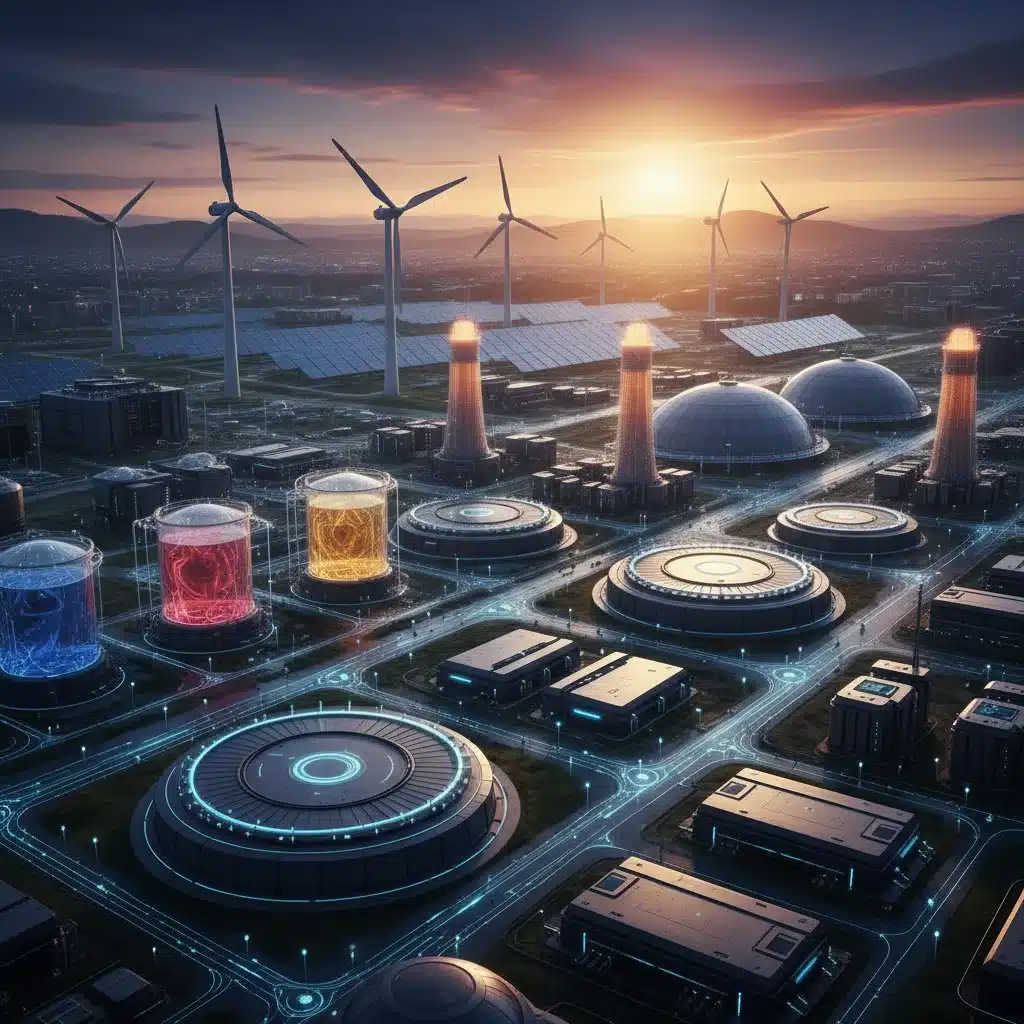
The energy landscape in the United States is undergoing a profound transformation. With an accelerating push towards decarbonization and a growing reliance on intermittent renewable energy sources, the demand for robust and diverse energy storage solutions has never been more critical. While lithium-ion batteries have dominated the market in recent years, their limitations in terms of supply chain, cost for long-duration applications, and environmental impact are prompting US utilities to look beyond the current paradigm. As we approach 2026, several emerging energy storage technologies are poised to play a pivotal role in grid modernization, offering compelling alternatives to lithium-ion.
This article delves into four such promising technologies that are gaining significant traction among US utilities. We will explore their operational principles, advantages, challenges, and the potential impact they could have on grid stability, renewable integration, and overall energy resilience. Understanding these innovations is crucial for stakeholders navigating the evolving energy sector and preparing for a future where energy storage is not just an add-on, but a foundational element of the power system.
The Imperative for Diverse Emerging Energy Storage Solutions
The electric grid in the United States faces a multifaceted challenge: maintaining reliability and resilience while transitioning to a cleaner, more sustainable energy mix. Renewable energy sources like solar and wind, while environmentally beneficial, introduce variability into the grid. Clouds can obscure the sun, and wind speeds can fluctuate, leading to unpredictable power generation. Energy storage acts as a crucial buffer, capturing excess energy during periods of high generation and releasing it when demand is high or renewable output is low. This balancing act is essential for grid stability and for maximizing the utilization of renewable assets.
Lithium-ion batteries have been instrumental in this transition, particularly for short-to-medium duration applications. However, their scalability for very long durations (e.g., 8+ hours), reliance on specific rare earth minerals, and concerns about thermal runaway in certain applications present a clear need for diversification. US utilities are actively seeking emerging energy storage solutions that can offer different performance characteristics, improved safety, lower environmental footprints, and ultimately, a more secure and resilient energy future. The focus is shifting towards technologies that can provide flexibility, long-duration discharge, and cost-effectiveness at grid scale.
The drive for diverse emerging energy storage options is also fueled by economic considerations. As the demand for storage grows, so does the pressure to reduce costs and improve efficiency. Different technologies will find their niche based on specific grid needs, geographic conditions, and economic viability. This competitive landscape will ultimately benefit consumers and accelerate the clean energy transition. The next few years, particularly leading up to 2026, will be critical in determining which of these emerging technologies will achieve widespread adoption.
1. Vanadium Redox Flow Batteries (VRFBs): The Long-Duration Contender
How Vanadium Redox Flow Batteries Work
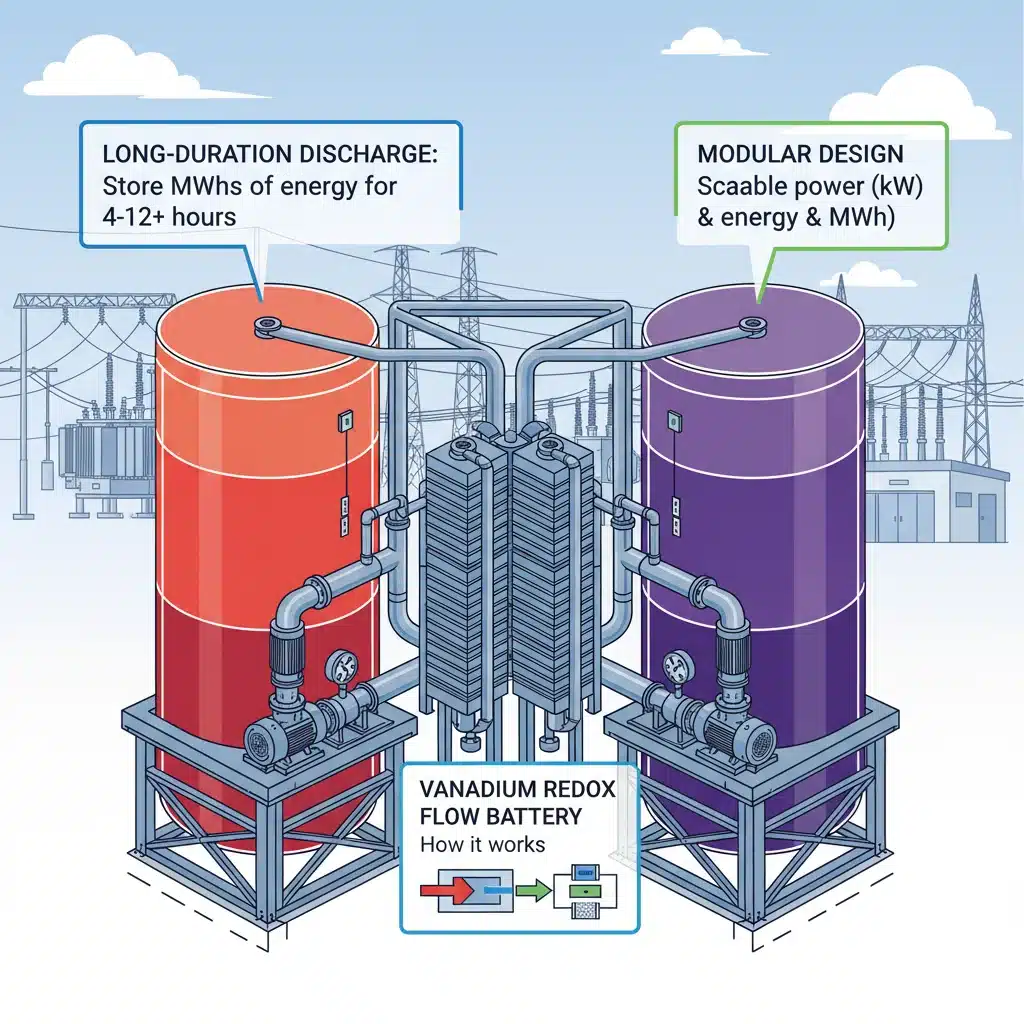
Vanadium Redox Flow Batteries (VRFBs) represent a compelling alternative for long-duration energy storage. Unlike conventional batteries that store energy within solid electrodes, VRFBs store energy in liquid electrolyte solutions contained in external tanks. These electrolytes are pumped through a central cell stack where electrochemical reactions occur, charging or discharging the battery. The key to VRFBs lies in their use of vanadium ions in different oxidation states, dissolved in an aqueous sulfuric acid solution. During charging, vanadium ions are oxidized at one electrode and reduced at the other. The process is reversed during discharge.
The separation of power and energy components is a defining characteristic of VRFBs. The power output is determined by the size of the cell stack, while the energy capacity is dictated by the volume of the electrolyte tanks. This modular design allows for independent scaling of power and energy, making VRFBs highly adaptable to various grid requirements. For instance, increasing the duration of discharge simply requires larger electrolyte tanks, without needing to expand the cell stack.
Advantages for US Utilities
- Long Duration Storage: VRFBs excel in applications requiring several hours to days of discharge, making them ideal for managing renewable intermittency and providing grid stability over extended periods. This is a critical factor for US utilities looking to integrate more solar and wind power.
- Scalability and Flexibility: The independent scaling of power and energy allows for tailored solutions. Utilities can easily expand energy capacity by adding more electrolyte, providing significant operational flexibility.
- Long Lifespan and Deep Cycling: VRFBs can undergo tens of thousands of charge-discharge cycles with minimal degradation, offering a very long operational life (often 20+ years). They can also be deeply discharged without significant performance loss, which is a major advantage over lithium-ion.
- Safety: The aqueous electrolyte is non-flammable, significantly reducing fire risks compared to some other battery chemistries. This inherent safety feature is a strong selling point for large-scale grid deployments.
- Resource Abundance: Vanadium is a relatively abundant metal, and the electrolyte can be recycled almost indefinitely, offering a more sustainable supply chain compared to lithium and cobalt.
Challenges and Outlook for 2026
Despite their advantages, VRFBs face challenges. Their initial capital cost can be higher than lithium-ion for shorter durations, and their energy density is lower, meaning they require more space. Electrolyte management and potential self-discharge over very long periods also need careful consideration. However, ongoing research is focused on reducing costs, improving energy density, and enhancing system efficiency. As manufacturing scales up and technological advancements continue, VRFBs are expected to become increasingly competitive. By 2026, with supportive policies and continued investment, VRFBs are projected to see significant deployment in utility-scale, long-duration applications across the US, especially in regions with high renewable penetration.
2. Solid-State Batteries: The Next Frontier in Battery Safety and Performance
The Evolution of Solid-State Batteries
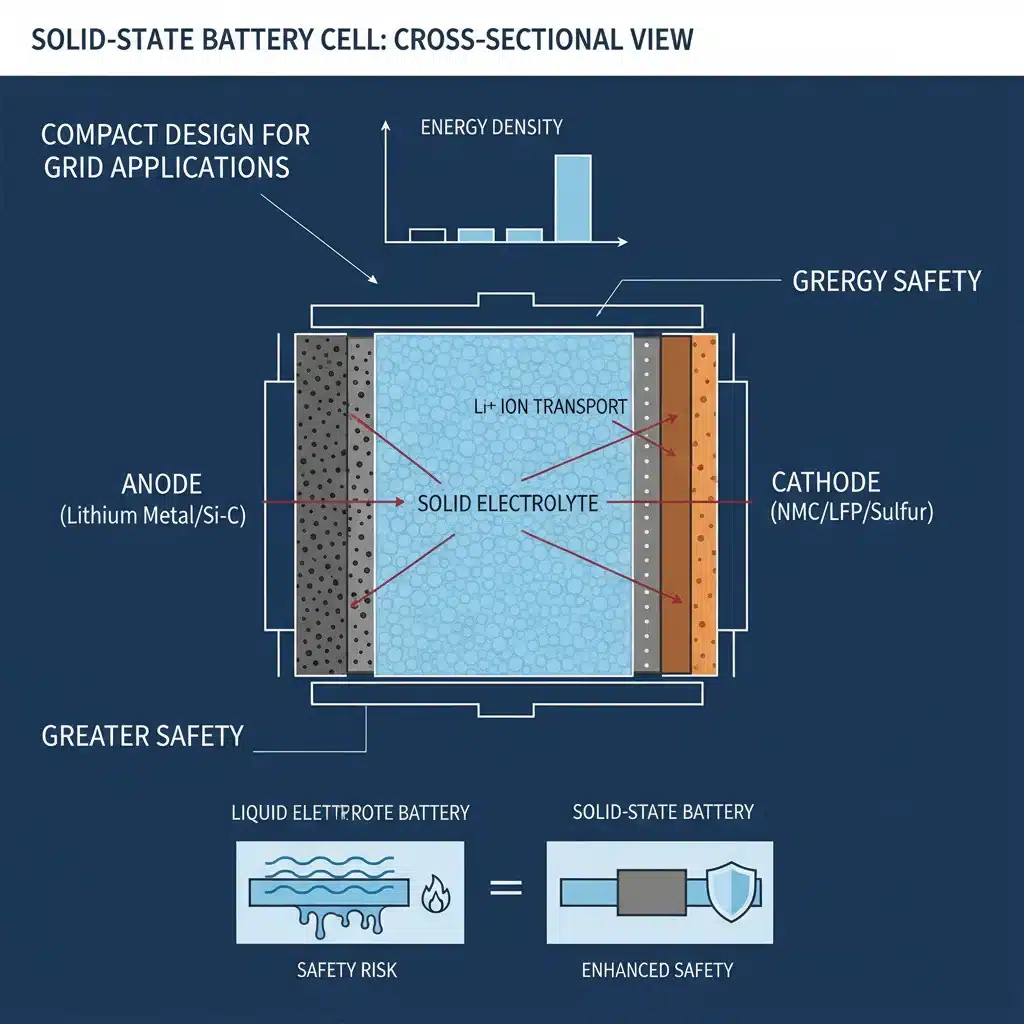
Solid-state batteries (SSBs) represent a paradigm shift in battery technology, replacing the flammable liquid or gel electrolytes found in conventional lithium-ion batteries with a solid material. This solid electrolyte can be ceramic, glass, or a solid polymer. The concept has been around for decades, but recent breakthroughs in material science and manufacturing processes are bringing SSBs closer to commercial viability, particularly for high-performance and high-safety applications.
The elimination of liquid electrolytes addresses several key limitations of lithium-ion batteries, including safety concerns related to thermal runaway and the potential for dendrite formation, which can lead to short circuits and reduced lifespan. SSBs promise a future with safer, more energy-dense, and potentially faster-charging batteries.
Advantages for US Utilities
- Enhanced Safety: The primary advantage of SSBs is their inherent safety. The solid electrolyte is non-flammable and less prone to thermal runaway, making them ideal for densely populated areas or critical infrastructure where safety is paramount. This is a huge draw for US utilities.
- Higher Energy Density: SSBs have the potential to achieve significantly higher energy densities than lithium-ion batteries. This means more energy can be stored in a smaller, lighter package, which could lead to more compact grid storage installations and more efficient use of land.
- Longer Lifespan: With reduced degradation mechanisms, SSBs are expected to offer longer cycle lives, translating to lower lifetime costs and improved return on investment for utilities.
- Wider Operating Temperature Range: Some solid electrolytes can operate effectively across a broader temperature range, reducing the need for extensive thermal management systems and improving performance in diverse climates.
- Faster Charging: While still under development, some SSB chemistries show promise for ultra-fast charging capabilities, which could be beneficial for certain grid services requiring rapid energy response.
Challenges and Outlook for 2026
Despite their immense promise, SSBs face significant hurdles before widespread utility adoption. Manufacturing at scale remains complex and expensive, and ensuring good interfacial contact between the solid electrolyte and electrodes is critical for performance. The conductivity of solid electrolytes is generally lower than liquid ones, which can impact power delivery. However, massive investments from automotive and energy companies are accelerating research and development. By 2026, while not expected to fully replace lithium-ion, solid-state batteries are likely to see initial deployments in niche high-value grid applications where safety and energy density are paramount. Their role as an emerging energy storage technology will grow steadily, with continued cost reductions and performance improvements.
3. Advanced Compressed Air Energy Storage (A-CAES): Leveraging Geologic Formations
The Mechanics of A-CAES
Compressed Air Energy Storage (CAES) is a mature technology, but Advanced CAES (A-CAES) is an emerging energy storage variant that addresses some of its limitations. Traditional CAES systems store electrical energy by compressing air and storing it in underground caverns (salt domes, depleted natural gas reservoirs, or hard rock mines). When electricity is needed, the compressed air is released, heated, and expanded through a turbine to generate power. The heating process often uses natural gas, which is a drawback for decarbonization goals.
A-CAES innovates by incorporating thermal energy storage (TES) or isothermal compression/expansion to significantly reduce or eliminate the need for fossil fuel combustion. In A-CAES, the heat generated during compression is captured and stored, then reused to heat the air during expansion, dramatically improving efficiency and environmental performance. This makes A-CAES a truly clean, long-duration storage solution.
Advantages for US Utilities
- Large-Scale, Long-Duration Storage: A-CAES systems can store vast amounts of energy for extended periods (days to weeks), making them ideal for seasonal storage or managing prolonged periods of low renewable output. This capacity is unmatched by most battery technologies.
- Geographic Versatility: While requiring suitable underground geological formations, these formations are found in many parts of the US, offering strategic placement opportunities for utilities.
- High Efficiency (A-CAES): By integrating thermal energy recovery, A-CAES significantly boosts round-trip efficiency compared to conventional CAES, often reaching 70% or higher.
- Long Asset Life: CAES plants have operational lifespans of 30-40 years, comparable to traditional power plants, offering a long-term investment for utilities.
- Environmentally Friendly: A-CAES, by minimizing or eliminating fossil fuel use, aligns perfectly with decarbonization goals and offers a non-toxic, sustainable storage option.
Challenges and Outlook for 2026
The primary challenge for A-CAES is the need for specific geological formations, which limits siting options. Initial capital costs are also high due to the scale and civil engineering requirements. However, once built, operational costs are relatively low. The technology is capital-intensive but offers immense capacity. As the need for long-duration, grid-scale storage intensifies, particularly for balancing large renewable portfolios, A-CAES is expected to see increased interest and development. By 2026, several pilot and commercial-scale A-CAES projects are likely to be underway or operational in the US, demonstrating their potential as a foundational emerging energy storage technology for a resilient grid.
4. Thermal Energy Storage (TES): Harnessing Heat for Grid Stability
Understanding Thermal Energy Storage
Thermal Energy Storage (TES) involves storing energy in the form of heat or cold for later use. While TES has been used for decades in industrial processes and building HVAC, its application for grid-scale electricity storage is an exciting emerging energy storage frontier. The principle is simple: convert excess electrical energy into thermal energy, store it, and then convert it back into electricity when needed, or use the heat directly.
Various mediums can be used for TES, including molten salts, concrete, rocks, or phase-change materials (PCMs). For grid applications, systems often involve heating a storage medium using electric heaters during off-peak hours or when renewable generation is high. When electricity is required, the stored heat is used to generate steam, which drives a turbine to produce electricity. Alternatively, the stored heat can be used for industrial processes or district heating, reducing overall energy demand.
Advantages for US Utilities
- Cost-Effectiveness for Long Duration: For very long-duration storage (hours to days), TES can be significantly more cost-effective than electrochemical batteries, especially when using abundant and inexpensive storage mediums like rocks or sand.
- Scalability: TES systems can be scaled to very large capacities, suitable for utility-scale applications. The amount of energy stored is primarily limited by the volume of the storage medium.
- Resource Abundance: Many TES mediums (sand, rocks, water, molten salt) are readily available and inexpensive, reducing supply chain risks and environmental concerns associated with critical minerals.
- Synergy with Industrial Processes: TES can be integrated with existing industrial facilities that require process heat, offering synergistic benefits and improving overall energy efficiency.
- Safety and Durability: Most TES mediums are non-flammable and stable, offering a safe and durable storage solution with long operational lifespans.
Challenges and Outlook for 2026
The primary challenges for TES in grid applications include the round-trip efficiency (converting electricity to heat and back to electricity often involves some losses), the footprint required for large-scale systems, and the need for efficient heat exchangers and power conversion units. The speed of response can also be slower than batteries, making them less suitable for instantaneous grid balancing but excellent for bulk energy shifting.
However, advancements in materials science (e.g., higher temperature PCMs) and system integration are improving efficiency and reducing costs. By 2026, TES is expected to emerge as a strong contender for long-duration, bulk energy storage, particularly in regions with high industrial heat demand or where land availability allows for large installations. Utilities are increasingly exploring TES as a complementary technology to electrochemical batteries, providing a robust and sustainable component to their overall emerging energy storage portfolio.
The Road Ahead for Emerging Energy Storage in US Utilities
The journey towards a fully decarbonized and resilient grid is complex, and emerging energy storage technologies are undoubtedly at its core. While lithium-ion batteries will continue to play a vital role, the limitations of any single technology underscore the need for a diversified portfolio. The four technologies discussed – Vanadium Redox Flow Batteries, Solid-State Batteries, Advanced Compressed Air Energy Storage, and Thermal Energy Storage – each offer unique strengths that can address different facets of the grid’s needs.
For US utilities, the strategic integration of these diverse storage solutions by 2026 will be paramount. This involves not only technological development but also supportive regulatory frameworks, innovative financing mechanisms, and robust grid planning. Investment in research and development, pilot projects, and scaled deployments will be essential to mature these technologies and bring down their costs. Furthermore, collaboration between utilities, technology providers, and policymakers will be key to overcoming deployment hurdles and accelerating adoption.
The future grid will not rely on a single silver bullet but rather on a sophisticated ecosystem of interconnected, intelligent, and diverse energy storage assets. Each emerging energy storage technology will find its optimal application, contributing to a more stable, efficient, and sustainable power system. As we look towards 2026 and beyond, the proactive exploration and integration of these innovative solutions will define the success of the US energy transition, ensuring reliable power for generations to come and cementing the role of energy storage as a cornerstone of modern infrastructure.
Conclusion
The shift away from fossil fuels and towards a renewable-dominated energy landscape necessitates a corresponding evolution in energy storage capabilities. US utilities are at the forefront of this evolution, actively seeking and deploying emerging energy storage technologies that can provide the necessary flexibility, duration, and safety. Vanadium Redox Flow Batteries offer long-duration, scalable, and safe solutions. Solid-State Batteries promise higher energy density and unparalleled safety for specific applications. Advanced Compressed Air Energy Storage provides massive, long-term storage capacity, leveraging geological formations. Thermal Energy Storage presents a cost-effective option for bulk energy shifting and industrial synergies.
By 2026, we anticipate significant advancements and increased deployment across all these fronts. The strategic combination of these diverse emerging energy storage options will empower US utilities to manage the complexities of a renewable-heavy grid, enhance resilience against disruptions, and ultimately deliver cleaner, more reliable, and affordable energy to consumers. The era of a diversified energy storage portfolio is not just on the horizon; it’s rapidly becoming a reality, shaping the future of power in America.