Beyond Lithium-Ion: 5 Emerging Batteries for 2025
Anúncios
The urgent demand for more efficient and sustainable energy storage is propelling research into alternatives to lithium-ion, with five emerging battery technologies showing significant promise for widespread adoption by 2025.
The quest for more efficient, safer, and sustainable energy storage solutions has never been more critical. While lithium-ion batteries have powered our technological advancements for decades, their limitations in terms of resource availability, cost, and safety are becoming increasingly apparent. This exploration delves into the fascinating world of emerging battery technologies 2025, presenting five groundbreaking alternatives poised to redefine energy storage in the coming years.
The Limitations of Lithium-Ion and the Drive for Innovation
Lithium-ion batteries have been a cornerstone of modern electronics and electric vehicles, offering high energy density and rechargeability. However, the reliance on cobalt and nickel, often sourced unethically and with significant environmental impact, presents a pressing challenge. Furthermore, the risk of thermal runaway and the relatively slow charging times highlight areas where innovation is desperately needed.
The global push towards decarbonization and renewable energy integration necessitates a paradigm shift in battery technology. Researchers and engineers worldwide are tirelessly working to develop next-generation batteries that can overcome these hurdles, offering enhanced performance, greater safety, and a more sustainable footprint. These efforts are not just about incremental improvements; they aim for revolutionary breakthroughs that can fundamentally alter how we store and utilize energy.
Resource Scarcity and Environmental Impact
The extraction of lithium, cobalt, and nickel often involves environmentally damaging processes and raised ethical concerns regarding labor practices. As demand for electric vehicles and grid-scale storage escalates, the strain on these finite resources will intensify, potentially leading to price volatility and supply chain disruptions.
- Cobalt Dependency: A major component in many lithium-ion cathodes, cobalt’s supply chain is often fraught with ethical concerns.
- Lithium Extraction: Water-intensive processes for lithium extraction can impact local ecosystems.
- Recycling Challenges: Current recycling methods for lithium-ion batteries are complex and not yet economically viable on a large scale.
These limitations are driving the imperative to explore chemistries that utilize more abundant, less toxic, and easily recyclable materials, ensuring a sustainable energy future.
Solid-State Batteries: The Promise of Enhanced Safety and Density
Solid-state batteries represent one of the most anticipated breakthroughs in energy storage. Unlike traditional lithium-ion batteries that use liquid electrolytes, solid-state batteries employ a solid electrolyte, eliminating the risk of leakage and significantly reducing the chance of thermal runaway. This inherent safety advantage is a major driving force behind their development, particularly for electric vehicles and aerospace applications.
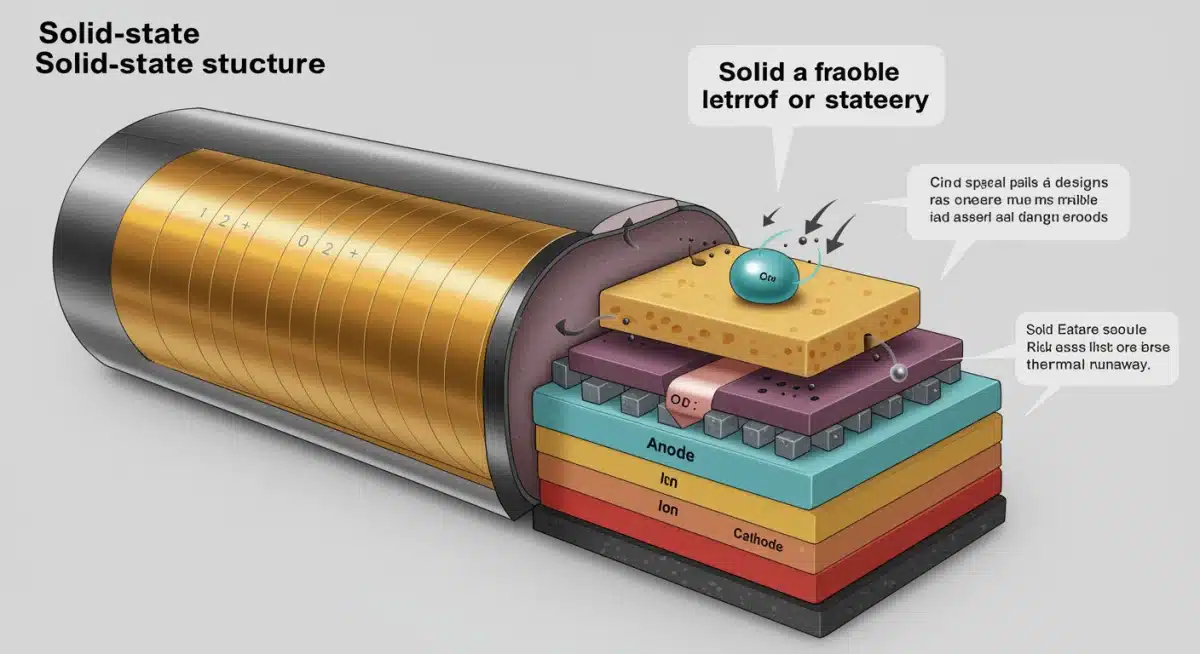
Beyond safety, solid-state batteries promise higher energy densities, meaning they can store more energy in a smaller and lighter package. This could translate into longer ranges for electric vehicles and extended operating times for portable devices. The development challenges primarily lie in finding solid electrolytes with high ionic conductivity and ensuring stable interfaces between the electrolyte and electrodes.
Key Advantages of Solid-State Technology
The shift from liquid to solid electrolytes brings a host of benefits that could revolutionize battery performance and safety. Researchers are focusing on various solid electrolyte materials, including polymers, sulfides, and oxides, each with its own set of advantages and challenges.
- Increased Safety: Eliminates flammable liquid electrolytes, drastically reducing fire hazards.
- Higher Energy Density: Potential for greater energy storage in a smaller volume, leading to lighter batteries and longer device life.
- Longer Lifespan: Improved stability of solid electrolytes can lead to more charge/discharge cycles.
- Faster Charging: Some solid electrolytes can facilitate quicker ion transfer, enabling faster charging.
The commercialization of solid-state batteries is expected to pick up pace by 2025, with several companies already showcasing prototypes and planning production facilities, signaling a significant step forward in battery technology.
Sodium-Ion Batteries: A Sustainable and Cost-Effective Alternative
Sodium-ion batteries are rapidly gaining attention as a viable and sustainable alternative to lithium-ion, primarily due to the abundance and low cost of sodium. Sodium is readily available globally, unlike lithium, which is concentrated in a few regions. This makes sodium-ion batteries an attractive option for large-scale energy storage applications, such as grid stabilization and renewable energy integration.
While sodium-ion batteries typically offer a slightly lower energy density compared to their lithium counterparts, their cost-effectiveness and improved safety profile make them highly competitive. They also perform well in a wider range of temperatures and can be fully discharged without damage, simplifying transportation and storage. Significant advancements in electrode materials and cell design are continuously improving their performance, bridging the gap with lithium-ion.
Benefits for Grid-Scale Storage
The economic and environmental advantages of sodium-ion batteries make them particularly well-suited for stationary energy storage. Their ability to operate efficiently in varying temperature conditions and their inherent safety contribute to their appeal for these demanding applications.
- Abundant Resource: Sodium is widely available and inexpensive, reducing geopolitical risks and material costs.
- Enhanced Safety: Less prone to thermal runaway compared to some lithium-ion chemistries.
- Cost-Effective: Lower material costs translate to more affordable battery systems.
- Wide Temperature Range: Excellent performance in both high and low temperatures.
As research continues to boost their energy density and cycle life, sodium-ion batteries are poised to play a crucial role in the transition to a fully renewable energy grid by 2025 and beyond.
Flow Batteries: Scalable Solutions for Grid Stabilization
Flow batteries, particularly redox flow batteries, offer a unique approach to energy storage, separating the energy-storing electrolyte from the power-generating cell stack. This design allows for independent scaling of energy capacity and power output, making them exceptionally well-suited for large-scale, long-duration energy storage applications, such as grid stabilization and industrial power backup.
The ability to store large volumes of electrolyte in external tanks means that flow batteries can provide energy for hours or even days, far exceeding the capabilities of most conventional batteries. They also boast an impressive cycle life, with minimal degradation over thousands of charge-discharge cycles. While their energy density is lower than lithium-ion, their scalability, longevity, and safety make them indispensable for grid-level applications.
Advantages of Flow Battery Architecture
The distinct architecture of flow batteries provides inherent benefits that address specific energy storage needs, particularly for long-duration applications where traditional batteries fall short.
- Independent Scaling: Power and energy capacity can be scaled independently, offering flexibility in design.
- Long Duration Storage: Capable of storing energy for extended periods, ideal for grid support.
- Exceptional Longevity: Minimal degradation over thousands of cycles, leading to a long operational life.
- Enhanced Safety: Non-flammable electrolytes and physical separation of components reduce safety risks.
As renewable energy sources like solar and wind become more prevalent, the demand for reliable, long-duration storage solutions will grow, positioning flow batteries as a critical technology for 2025 and beyond.
Magnesium-Ion Batteries: High Potential for Future Applications
Magnesium-ion batteries are an exciting area of research, offering several compelling advantages over lithium-ion. Magnesium is far more abundant and less expensive than lithium, making it a highly attractive material for future battery chemistries. Furthermore, magnesium ions are divalent, meaning they can carry twice the charge of monovalent lithium ions, theoretically allowing for higher energy densities.
The development of magnesium-ion batteries is still in its early stages, primarily due to challenges in finding suitable electrolytes and cathode materials that allow for efficient and reversible magnesium ion intercalation. However, significant progress is being made, and researchers are optimistic about their potential to deliver high performance with enhanced safety and sustainability. Their non-dendritic deposition also mitigates the risk of short circuits, a common issue in lithium-ion batteries.
Addressing the Challenges and Unlocking Potential
Despite the hurdles, the promise of magnesium-ion technology is immense. Overcoming current limitations could pave the way for a new generation of batteries that are both powerful and environmentally friendly.
- Abundant and Affordable: Magnesium is readily available, reducing material costs and supply chain concerns.
- High Energy Density Potential: Divalent ions could lead to greater energy storage capacity.
- Improved Safety: Magnesium does not form dendrites, reducing the risk of short circuits and fires.
- Environmental Friendliness: Less toxic and easier to recycle than some lithium-ion components.
With ongoing research focused on developing novel electrode materials and stable electrolytes, magnesium-ion batteries could emerge as a powerful contender in the energy storage landscape by 2025.
Zinc-Air Batteries: High Energy Density and Low Cost
Zinc-air batteries are another promising technology, distinguished by their high theoretical energy density and the use of abundant, inexpensive materials. These batteries use oxygen from the air as a reactant, which significantly reduces the amount of active material that needs to be stored within the battery itself, leading to a lighter and more compact design. The primary components, zinc and air, are both widely available and environmentally benign.
Currently, zinc-air batteries are largely used in non-rechargeable applications, such as hearing aids, due to challenges in developing efficient and long-lasting rechargeable versions. However, recent breakthroughs in catalyst development and electrode design are making rechargeable zinc-air batteries a more realistic prospect for grid-scale storage and even electric vehicles. Their low cost and inherent safety profile make them highly attractive for various applications.
Key Advantages and Future Prospects
The unique chemistry of zinc-air batteries offers a compelling combination of performance and sustainability, positioning them as a strong candidate for future energy storage needs.
- High Energy Density: Utilizes atmospheric oxygen, reducing the weight of active materials.
- Low Cost Materials: Zinc is abundant and inexpensive, contributing to lower manufacturing costs.
- Environmental Friendliness: Non-toxic components and readily available materials.
- Enhanced Safety: Reduced risk of thermal runaway compared to lithium-ion batteries.
As researchers continue to improve their rechargeability and cycle life, zinc-air batteries are expected to gain traction as a cost-effective and high-performance solution, further diversifying the landscape of emerging battery technologies 2025.
Impact on Grid Modernization and Electric Vehicles
The emergence of these advanced battery technologies beyond lithium-ion holds profound implications for two critical sectors: grid modernization and electric vehicles. For grid modernization, the ability to store vast amounts of renewable energy reliably and cost-effectively is paramount. Flow batteries and sodium-ion batteries, with their scalability and lower material costs, are ideally suited to integrate intermittent solar and wind power, ensuring a stable and resilient electricity supply.
In the electric vehicle market, solid-state batteries promise to revolutionize performance by offering longer ranges, faster charging times, and significantly improved safety. This could alleviate range anxiety and accelerate the adoption of EVs globally. Magnesium-ion and zinc-air batteries, while still in earlier stages of development, also offer the potential for even lower costs and higher energy densities, further democratizing access to clean transportation. These innovations are not just about replacing existing technology; they are about enabling new possibilities and accelerating the global transition to a sustainable energy future.
Transforming Energy Infrastructure
The drive for a greener future hinges on robust energy storage. These new battery chemistries offer tailored solutions for diverse needs, from personal electronics to national grids.
- Renewable Energy Integration: Enables efficient storage of solar and wind power, reducing reliance on fossil fuels.
- Grid Stability: Provides backup power and balances demand fluctuations, preventing blackouts.
- Decentralized Energy Systems: Supports microgrids and off-grid solutions, increasing energy independence.
The collective impact of these innovations will be a more resilient, sustainable, and democratized energy landscape, paving the way for a truly green economy.
| Technology | Key Benefit |
|---|---|
| Solid-State Batteries | Enhanced safety, higher energy density |
| Sodium-Ion Batteries | Sustainable, cost-effective, abundant materials |
| Flow Batteries | Scalable, long-duration grid storage |
| Magnesium-Ion Batteries | High potential energy density, safer chemistry |
Frequently Asked Questions About Emerging Battery Technologies
Lithium-ion batteries face challenges including resource scarcity, high material costs, ethical concerns regarding cobalt mining, and a risk of thermal runaway. Their energy density also has practical limits for certain applications, driving the search for superior alternatives.
Solid-state batteries use a solid electrolyte instead of a flammable liquid one, virtually eliminating the risk of leakage, fire, and thermal runaway. This makes them inherently safer for applications like electric vehicles and consumer electronics, enhancing overall user confidence.
Sodium is far more abundant and evenly distributed globally than lithium, reducing environmental impact and geopolitical dependencies. This makes sodium-ion batteries a more sustainable and cost-effective option, particularly for large-scale energy storage where material cost is critical.
Flow batteries excel in long-duration, grid-scale energy storage applications. Their unique architecture allows for independent scaling of power and energy, making them ideal for integrating intermittent renewable energy sources and stabilizing electricity grids over extended periods, often days.
While some, like advanced solid-state and sodium-ion, are projected for more widespread commercialization by 2025, others like magnesium-ion and advanced zinc-air are still undergoing intensive research and development, with broader adoption expected in the later half of the decade.
Conclusion
The journey beyond lithium-ion batteries is not merely an incremental step but a transformative leap towards a more sustainable and efficient energy future. The five emerging battery technologies — solid-state, sodium-ion, flow, magnesium-ion, and zinc-air — each offer unique advantages that address the limitations of current solutions. By 2025, we anticipate significant advancements and broader commercialization of these innovations, fundamentally reshaping how we power our world, from electric vehicles to vast energy grids. These developments underscore a collective global effort to harness cleaner, safer, and more abundant resources, ensuring a resilient energy landscape for generations to come. The future of energy storage is diverse, dynamic, and full of promise.